
How we got here
Some thoughts on 'yokel locals' and the bid to protect the Lower Dolores River
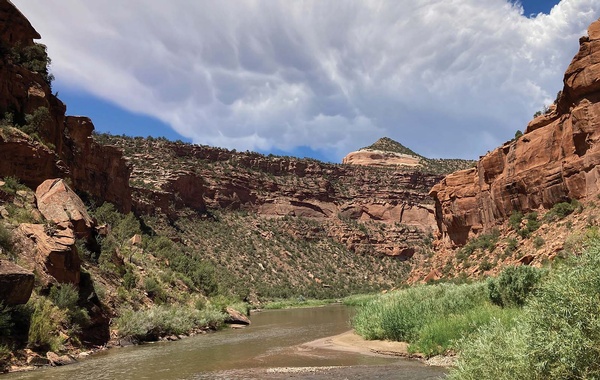
The confluence of the Lower Dolores and San Miguel rivers./ Photo by Jonathan P. Thompson.
The News: Western Colorado’s Mesa and Montrose counties propose a 30,000-acre national conservation area for the Lower Dolores River corridor as an alternative to the proposed 400,000-acre national monument. While this may look like a peace offering or compromise from counties that have opposed protections, it is likely an attempt to block any sort of designation and will probably only fan the flames of controversy. It’s the latest volley in a half-century battle over the fate of the beleaguered river.
The Context: The current controversy over the Dolores River takes me back to when I was a youngster in the early ‘80s. McPhee Dam was under construction on the Dolores River, its proponents having vanquished a movement that sought to block the dam and keep the river free. My parents had been on the losing side of the fight, and I can distinctly remember my father blaming the defeat, at least in part, on outsider environmentalists – including Ed Abbey – deriding the pro-dam contingent as a bunch of “local yokels.”
I’m sure my dad took it personally. He was a fourth-generation rural Coloradan, had graduated from Dolores High School, and his mom and sisters still lived in Dolores – apparently making him a “yokel.” But also he saw it as a strategic misstep. Not only were these people insulting locals, but they were falling into the pro-dam contingent’s trap, bolstering the dam-building effort.
More often than not, these land-protection fights are framed as well-heeled elitist outsiders and Washington bureaucrats imposing their values on and wrecking the livelihoods of rural, salt-of-the- earth local ranchers and miners. And in almost every case it is a gross oversimplification and, at worst, an inaccurate portrayal and a cynical attempt to disempower locals – and anyone else – who favor land protection. So when those anti-dam folks caricatured the pro-dam contingent as yokels, they were not only alienating locals who may have been on their side, but also validating the false depiction of the situation.
We saw this play out in the battle over Bears Ears National Monument. The anti- monument contingent insisted that all “locals” were opposed to the monument – and the media largely bought into it – never mind that the effort to establish a monument was driven by Navajo, Ute Mountain Ute and other tribal nations who have inhabited the landscape since time immemorial. Never mind that the anti-monument “locals” were backed by mining corporations, right-wing think tanks and conservative politicians from all over (including a Manhattan real estate magnate and reality TV personality who became president). Utah’s congressional delegation even had the gaul to attempt to disenfranchise and silence tribal leaders’ voices.
The movement to protect the Dolores River has been portrayed in much the same way. It has its roots in 1968, when U.S. Rep. Wayne Aspinall, a Democrat from Colorado’s Western Slope, pushed through the Colorado River Basin Project Act, authorizing the construction of five water projects. One of them was the Animas-La Plata Project, a byzantine tangle of dams, canals, tunnels and even power plants. Another was the Dolores Project, including McPhee Dam, which would impound water to lengthen the irrigation season for Montezuma Valley and send water to dryland bean farmers around Dove Creek.
The prospect of another river being stilled sparked a movement to block McPhee and designate the Lower Dolores as a Wild and Scenic River, which would have prohibited mining and oil and gas leasing, while also ensuring enough water to keep the river “wild and scenic.” Which is to say a lot more water than zero, which was historically the river’s flow from mid-summer into fall due to irrigation diversions.
Local farmers were generally in favor of the dam – and against Wild & Scenic designation, since it would likely deprive them of water during dry times. But their cause was also backed by powerful agricultural interests, pugnacious Durango attorney Sam Maynes, Sen. Gary Hart, D-Colo., and, probably most importantly, the Ute Mountain Ute Tribe, which would receive a portion of the water.
The project was ultimately authorized. Construction of McPhee began in 1979 and the reservoir filled in 1984. No matter how one feels about dams, it had some benefits. The federally funded Dolores Archaeological Program surveyed and studied the cultural sites that were spread across the area to be inundated by the reservoir. It was a huge project that significantly advanced scientific knowledge of the Ancestral Puebloans.
And, contrary to opponents’ fears, the dam didn’t kill the river. Rather it was like putting the river’s manic-depressive flows on lithium. The massive spring runoffs were tempered, but water managers released enough water in most years to scour beaches and preserve Snaggletooth Rapid’s snarl. And for the first time in a century, the Lower Dolores didn’t run dry in July. In fact, the year-round flows were enough to build and sustain a cold-water fishery for trout upstream and native fish downstream.
The Ute Mountain Ute Tribe got drinking water as well as enough to irrigate a major agricultural enterprise, providing much-needed economic development. The Town of Dove Creek received water as did the formerly dryland farmers, allowing them to diversify crops. The dam’s completion happened to coincide with the demise of the domestic uranium mining industry, meaning that threat mostly went away as well, along with the need for added protections.
Unfortunately, drier times set in. The megadrought, now going on a quarter century, has depleted flows and reservoir levels. To keep ditches flowing, dam managers have released almost no water in 14 of the last 24 years, essentially desiccating the stream and riparian ecology.
In the midst of it all, the uranium industry made a short-lived comeback between 2006-12. Now, it seems to be emerging from its zombified state once again and is targeting numerous sites along the Dolores. The river runs through the Paradox Formation, as well, meaning it could be targeted by lithium and potash miners.
Meanwhile, visitation to the Lower Dolores has ramped up – along with impacts – as social media reveals the canyons to more people, and the Moab crowd seeks new places to play.
All of that spawned new Wild & Scenic campaigns for the Lower Dolores, but after it became clear they couldn’t get past political hurdles, stakeholders came together on a compromise. They proposed a national conservation area on 60 miles of river below the dam, which would withdraw the land from new mining claims and oil and gas leases, bring more attention to the plight of this sorrowful and spectacular river, and possibly more funding to restoration efforts. But it would leave another 100 miles unprotected, in part because Mesa and Montrose counties withdrew support. Thus the proposal for President Biden to designate 400,000 acres as a national monument.
That proposal, perhaps predictably, has sparked a backlash and anti-national monument campaign partly fueled by disinformation. And, just as predictably, it’s being falsely framed as a fight of locals vs. outsiders. It’s true that a survey commissioned by Mesa County of about 1,200 registered voters in Mesa, Montrose and San Miguel counties found that 57% of respondents oppose the monument. But, that shows that quite a few support the initiative.
And the Center for Western Priorities found that the survey may be biased since its creators consulted with monument opponents, but not proponents, about questions and how to word them. For example, the survey precedes one set of questions with: “Currently, uranium mining in the Dolores River Canyon area … impacts the local economy by providing tax dollars and jobs. The current national monument proposal would allow some but not all existing permit holders to continue.”
But this is misleading, because uranium mining remains virtually dead, so the economic impact is zero. Furthermore, a national monument grandfathers in all existing valid mining claims and has no effect on patented (private) claims. So even if there were operating mines, a monument wouldn’t hamper operations. Other questions were similarly misleading, implying that a national monument would remove management from the BLM or Forest Service.
Tellingly, the survey also found that 72% of respondents support existing national monuments “such as Browns Canyon, Chimney Rock and Colorado National Monument.” Why? Because they value conservation, and they’ve seen that national monuments don’t hurt the economy, agriculture or access.
That they are less sure about a new national monument might have something to do with opponents’ simplistic and unfounded argument, which is that it could “impose severe economic hardships,” without explaining how.
Nevertheless, Mesa County used the survey to justify opposing the monument and proposing its scaled-down conservation area. Again, this tactic is an echo used by Bears Ears opponents. National conservation areas don’t inherently offer more or less protections or restrictions than monuments, but they do need to be passed by Congress.
Given how dysfunctional our Congress is, that could take years or even decades. Yet, the Lower Dolores needs help now. No, a national monument won’t solve all its problems; it may not help the river, itself, at all. Already the fight over the proposal has shone a spotlight on a remote, largely unknown area, which will surely draw more visitors and damage. A monument designation at least would provide protection against future development and burgeoning crowds.
The Land Desk is a newsletter from Jonathan P. Thompson, author of “River of Lost Souls,” “Behind the Slickrock Curtain” and “Sagebrush Empire.” To subscribe, go to: www.landdesk.org.
-

- 06/18/2026
- Where the plastic meets the road
- By Kathleen O'Connor
-
School District 9-R leads local effort to recycle hard-to-process plastic film
- Read More
-
- 06/11/2026
- Wild at heart
- By Luke Mehall
-
Remembering Katrina Blair’s crusade to reclaim the power of wild plants and lands
- Read More
-

- 06/11/2026
- Book Burro hits the road
- By Missy Votel
-
Maria’s vintage Airstream-turned-bookmobile aims to deliver free books across region
- Read More
-

- 06/11/2026
- Picking up speed
- By Missy Votel
-
Propelled by $1.1M in grants, Phase 2 of Silverton’s Baker’s Park to begin this summer
- Read More
- Un-making history
- 06/18/2026
-
Last week in this space, we told you about the bigly pushback against Trump’s attempt to white-wash American history at national parks. In trying to blot out the bad parts, in 2025 Trump announced an executive order titled "Restoring Truth and Sanity to American History" and directed Interior Secretary Doug Burgum to ensure monuments, memorials, statues and markers "do not contain descriptions, depictions or other content that inappropriately disparage Americans past or living."
- Not so fast
- 06/11/2026
-
Remember last year, when the Trump administration asked national park goers to “report any signs or other information that are negative about either past or living Americans or that fail to emphasize the beauty, grandeur and abundance of landscapes and other natural features”?
Well, it seems park-goers have pushed back, bigly.
- Getting gassed
- 06/04/2026
-
Gas prices are once again giving America something to complain about. And while the local beer meisters at Ska Brewing can’t fix the price at the pump, the brewery is offering one small bit of relief: a new light beer that costs one cent less than the price of a gallon of unleaded gas.
Introducing Ska’s newest brew: West’s Easy Light Lager, because “everything else is so hard.”
- Short legs, big party
- 05/28/2026
-
On most days, Tracy Harwood spends her time as a court clerk for the City of Durango. But next Thurs., June 4 – International Corgi Day – she hopes to bring something entirely different to town: short legs, wiggly butts and oversized personalities.