
The Colorado River crisis is here
States fail to reach a deal; Lake Powell deadpool appears imminent
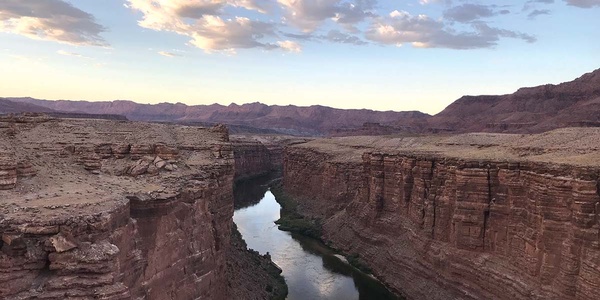
The Colorado River snakes its way down from Glen Canyon Dam through Marble Canyon. Upper and Lower Basin states have yet to agree on how to disperse the river's dwindling supply. Meanwhile, Lake Powell is flirting with dead pool, which could be devastating to downstream power supplies as well as the dam itself./ Telegraph file photo
by Jonathan Thompson
Valentine’s Day wasn’t so lovey-dovey on the Colorado River. First, the Bureau of Reclamation released a grimmer-than-ever spring runoff forecast for the Colorado River and its two big reservoirs. Then the seven Colorado River Basin states announced they once again had failed to reach an agreement on a plan to bring demand into line with diminishing supplies by the Feb. 14 deadline. While the states have blown by other deadlines since negotiations began in 2022, this time was different in that it triggered the federal government to move forward to impose a post-2026 management plan of its own.
On paper, the states still have until the end of the water year, or Oct. 1, to come up with a deal or to implement an alternate plan. But that may be too little too late to keep Lake Powell’s level from dropping below minimum power pool – otherwise known as dead pool – later this year. While the negotiations are over the Colorado River, or rather the water in the river, in many ways they pivot around the need to keep Lake Powell’s surface level above 3,500 feet. That can only be done by releasing less water out of Glen Canyon Dam, increasing flows into the reservoir or a bit of both.
The sticking point in negotiations hinges upon whether Upper Basin states will take mandatory and verifiable cuts in water use. Lower Basin states have already taken cuts and have agreed to take more but only if the Upper Basin does the same.
The Upper Basin (aka Headwaters states) points out that while the Lower Basin has maxed out and even exceeded its Colorado River Compact allocation of 7.5 million acre-feet per year, the Upper Basin hasn’t even come close to using all of the water it’s entitled to. Furthermore, Upper Basin water users, especially those with more junior water rights, have grappled with drastic reductions during dry years because the Upper Basin lacks large reservoirs for storage, meaning their water use is dictated, in large part, by the rivers’ flows. In 2021, for example, many Southwest Colorado farms had their ditches cut off as early as June, forcing them to sit the season out.
It’s also far simpler logistically to reduce consumption in the Lower Basin, where huge water users are served by a handful of very large diversions, such as the Central Arizona Project (which carries water to Phoenix and Tucson), the All-American Canal (serving the Imperial Irrigation District – the largest water user on the entire river), and the California Aqueduct (serving Los Angeles and other cities). Dialing back those three diversions alone could achieve the necessary reduction. The Upper Basin, on the other hand, pulls water from the river and its tributaries via hundreds of much smaller diversions. Achieving meaningful cuts would require shutting off thousands of irrigation ditches to thousands of water users under dubious authority.
Also, proposals to divert and consume more of the Colorado River’s water – such as the Lake Powell pipeline – remain on the table. If that project were to be realized, which is a big “if” these days, it would further drain Lake Powell and result in even less water flowing to the Lower Basin.
Environmental groups tend to side with the Lower Basin on this issue. If the Upper Basin is forced to pull less water from the river, it would leave more water riparian ecosystems and aquatic critters. The Upper Basin’s proposal to release a percentage of the river’s “natural flow” from Glen Canyon Dam would leave less water in the Colorado River through the Grand Canyon, possibly imperiling endangered fish and rafting.
Meanwhile, the states’ lack of consensus pushes Powell closer to the brink of deadpool.
The BuRec’s “Post-2026 Operational Guidelines and Strategies for Lake Powell and Lake Mead” offers five alternative scenarios for how to run the river. While it doesn’t give a “preferred” alternative, federal officials have indicated that without all of the states’ approval or congressional action, they are only authorized to go with the “Basic Coordination Alternative.” This would include a minimum annual release of 7 million acre-feet from Glen Canyon Dam, with the largest mandatory cuts being borne by Arizona. But, according to BuRec’s latest 24-month projection, that release would lead to Lake Powell’s surface level dropping below minimum power pool by the end of this year, which is a really big problem.
Back in 2022, as climate change continued to diminish the Colorado River’s flows and Lake Powell shrunk to alarmingly low levels, the dam’s operators were faced with the prospect of having to shut down the penstocks, or water intakes for the hydroelectric turbines, and only release water from the river outlets lower on the dam. Not only would this zero out electricity production from the dam, along with nixing up to $200 million in revenue from selling that power, it might also compromise the dam itself.
“Glen Canyon Dam was not envisioned to operate solely through the outworks for an extended period of time,” Tanya Trujillo, then-Interior Department assistant secretary for water and science, said in 2022. “Operating at this low lake level increases risks to water delivery and potential adverse impacts to downstream resources and infrastructure … Glen Canyon Dam facilities face unprecedented operational reliability challenges.”
In March 2024, a BuRec memorandum verified those risks and recommended that dam operators “not rely on the river outlet works as the sole means for releasing water from Glen Canyon Dam.”
The only way to do that is to keep the water level above 3,490 feet in elevation, which could mean shifting Glen Canyon Dam to a run-of-the-river operation – where releases equal Lake Powell inflows minus evaporation and seepage – as soon as this fall. That, most likely, will lead to annual releases far below 7 million acre-feet, will then lead to Lake Mead being drawn down considerably thereby threatening Lower Basin supplies. Such a scenario is clearly not sustainable, would put the Upper Basin states in violation of the Colorado River Compact and most certainly lead to litigation.
An irony here is that Glen Canyon Dam’s primary purpose is to allow the Upper Basin to store water during wet years and release it during dry years, enabling it to meet its Compact obligations. Hydropower, silt control and recreation were secondary purposes. Now, the need to preserve the dam could cause the Upper Basin to run afoul of the Compact. Aridification is rendering the dam obsolete, at least as a water storage savings account. Meanwhile, low levels are diminishing hydropower and recreation. It seems that soon, the dam’s main purpose will be to prevent Lake Mead from filling up with silt.
Mother Nature, or Mother Megadrought, if you prefer, has left few options for moving forward. The states still could come to an agreement, but it’s difficult to see how, given the long-running stalemate so far. The feds could reengineer Glen Canyon Dam to allow for sustained, low-water releases. That would only be a temporary fix, however, unless climatic trends reverse themselves, and the West suddenly becomes much wetter and cooler. Somehow, that doesn’t seem too likely.
The Land Desk is a newsletter from Jonathan P. Thompson, author of “River of Lost Souls,” “Behind the Slickrock Curtain” and “Sagebrush Empire.” To subscribe, go to: www.landdesk.org.
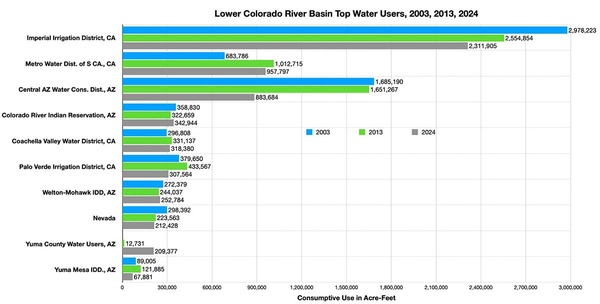
The Imperial Irrigation District is the largest single water user on the Colorado River by far. Most of that water goes to irrigating agriculture, including a fair amount of alfalfa and forage crops. Las Vegas uses about one-tenth the amount of water as the IID. Source: Bureau of Reclamation
-

- 05/21/2026
- Taming the ART
- By Missy Votel
-
City chooses education, striping over speed limit on River Trail
- Read More
-

- 05/21/2026
- Planned Parenthood reopens
-
PPRM president credits local community in getting clinic running again
- Read More
-

- 05/14/2026
- The quad squad
- By Missy Votel
-
Adult skate nights, DJs and a passionate crew fuel local roller skating renaissance
- Read More
-
- 05/14/2026
- Recharging the EV market
- By Allen Best / Big Pivots
-
High gas prices, revamped incentives aimed at rural drivers may help accelerate sales
- Read More
- River cowboy
- 05/21/2026
-
It’s a mash-up made in Westernwear heaven. Sort of. Seems Chaco, the purveyor of the iconic strappy dirtbag river rat footwear, has joined forces with Wrangler, as in tight jeans, big belt buckles, bull riding and snap shirt fame.
- Making plans
- 05/14/2026
-
Wondering what’s up with the old 9-R Admin building at the end of E. 2nd Avenue that was going to be a fire department, then wasn’t going to be a fire department and is now going to be City Hall and the Police Department?The City of Durango will demystify plans for the historic building during a public session Wed., May 20, 5:30-7:30 p.m. at the Durango Recreation Center.
- Going for the gold
- 04/30/2026
-
Turns out, blondes do have more fun, or at least they get more awards. Last week, Ska Brewing won the gold medal for its True Blonde Ale in the English-Style Pale Ale category at the 2026 World Beer Cup. This is the third win for the Blonde at the World Beer Cup, held in Philadelphia on April 22 and pegged as one of the world’s most prestigious beer competitions.
- Getting the blues
- 04/23/2026
-
After hitting the pause button in 2025, Blue Lakes is again open for business – with a few changes to how you do your, uh, business.