
Keeping the peace
Sharing the cost of range riders helps prevent depredation, bridge urban-rural divide
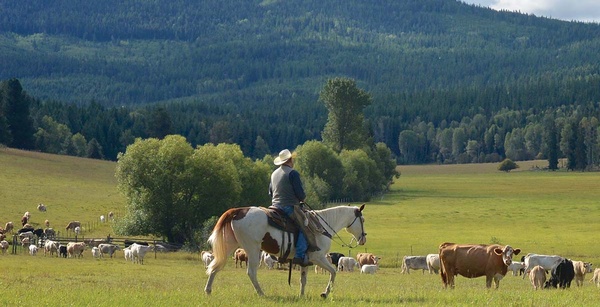
A range rider in Washington's Colville National Forest. Public and private donations have helped fund a range rider program in the state, which was successful in keeping wolf attacks on livestock relatively low./ Photo by Chase Gunnell
In 2008, Canadian wolves didn’t wait for an invitation from biologists to move into Washington state. Instead, they trotted across the border because they liked the territory.
The pair that found each other to form Washington’s first wolf pack came from far-flung places: the Canadian Rockies and the British Columbia coast. The spontaneous recolonization has become a notable success story.
Washington now has more than 230 wolves in at least 43 packs, living mostly in the northeastern part of the state. This area makes sense, as it is adjacent to wolf-populated wildlands in both Idaho and Canada. Wolves are amazing and ecologically vital, but also a challenge for the people they live among.
One rancher I know said, “When wolves first showed up, it felt like they were managing my cattle.”
The rancher finally regained control of his herd by using labor-intensive practices that deter wolves from preying on cattle. One of the most effective tools was a rider patrolling on horseback.
Range riders are specialized cowboys who keep the peace by providing a human shield. The riders bunch herds up at night when wolves are most active, and they make sure calves stay close to their moms.
While not infallible, range riding works well in keeping attacks on livestock relatively low while also reducing opposition to wolves. Human deterrence is costly, though. Contracting and managing range riders has cost up to $1 million each year. Washington has chosen to share the burden by funding ranchers willing to use these practices. Public and private dollars are funneled through two public agencies and the nonprofit that I direct, Conservation Northwest.
“Washington has more range riders than any other state,” Jay Shepherd, who directs Conservation Northwest’s wolf field program, said. As a result, Washington has the fewest depredations on livestock among states with established wolf packs, which means fewer wolves killed.
When wolf attacks do occur, the Washington Department of Fish and Wildlife may help a rancher use nonlethal tactics to deter wolves, ranging from fladry to rubber bullets. If the incidents cross a certain threshold, the department may kill one or more wolves.
The response is guided by an advisory group of stakeholders, ranging from wolf advocates to ranchers. The group has determined that preventing problems in the first place is most effective. Prevention is also appreciated by ranchers who didn’t like the compensation process after they’d lost cattle.
Sharing the cost of deterrence makes sense. Collaborating to fund peacekeeping tactics has also been a good way to bridge the persistent urban-rural divide.
Elsewhere, in states like Idaho and Wyoming, people kill more than a third of their state’s wolf population each year. In Washington, that mortality rate is under 5 percent.
Oregon has almost as many wolves as Washington, but combativeness is more the norm than collaboration in that state, resulting in twice as many dead cows and wolves. Bitter political conflict about wolves is also more evident in Oregon than in Washington, where the state’s bipartisan focus has been on funding deterrence.
California, with about 50 wolves, is newer to the arena. Its initiation to wolf drama came last year, when the Beyem Seyo pack killed more than 80 cows despite an expensive, but late, attempt at nonlethal disruption. The state ended up killing five wolves and relocating two more. Media reports described the wolves as “euthanized.”
In Colorado, a 2020 ballot initiative directed the state to bring wolves in from Canada. Although 25 wolves have been released, the effort has now been stalled by political polarization, which cost the head of the wildlife agency his job.
On the whole, if you’re a wolf, the best state to start a family is Washington – for now. Facing a tight budget, Washington halved its wolf funding in 2025. That means fewer range riders, more livestock depredations and angrier ranchers, along with litigation over a wolf-removal order.
If Washington can’t resume proper funding, its sterling record could end. If we can’t find the grace to continue the collaborative approach that we know works, everyone will lose.
Especially the wolves.
Mitch Friedman is a contributor to Writers on the Range, writersontherange.org, an independent nonprofit spurring lively conversation about the West. He heads Seattle-based Conservation Northwest, which he founded in 1989 after years organizing Earth First! protests.
-

- 06/18/2026
- Where the plastic meets the road
- By Kathleen O'Connor
-
School District 9-R leads local effort to recycle hard-to-process plastic film
- Read More
-
- 06/11/2026
- Wild at heart
- By Luke Mehall
-
Remembering Katrina Blair’s crusade to reclaim the power of wild plants and lands
- Read More
-

- 06/11/2026
- Book Burro hits the road
- By Missy Votel
-
Maria’s vintage Airstream-turned-bookmobile aims to deliver free books across region
- Read More
-

- 06/11/2026
- Picking up speed
- By Missy Votel
-
Propelled by $1.1M in grants, Phase 2 of Silverton’s Baker’s Park to begin this summer
- Read More
- Un-making history
- 06/18/2026
-
Last week in this space, we told you about the bigly pushback against Trump’s attempt to white-wash American history at national parks. In trying to blot out the bad parts, in 2025 Trump announced an executive order titled "Restoring Truth and Sanity to American History" and directed Interior Secretary Doug Burgum to ensure monuments, memorials, statues and markers "do not contain descriptions, depictions or other content that inappropriately disparage Americans past or living."
- Not so fast
- 06/11/2026
-
Remember last year, when the Trump administration asked national park goers to “report any signs or other information that are negative about either past or living Americans or that fail to emphasize the beauty, grandeur and abundance of landscapes and other natural features”?
Well, it seems park-goers have pushed back, bigly.
- Getting gassed
- 06/04/2026
-
Gas prices are once again giving America something to complain about. And while the local beer meisters at Ska Brewing can’t fix the price at the pump, the brewery is offering one small bit of relief: a new light beer that costs one cent less than the price of a gallon of unleaded gas.
Introducing Ska’s newest brew: West’s Easy Light Lager, because “everything else is so hard.”
- Short legs, big party
- 05/28/2026
-
On most days, Tracy Harwood spends her time as a court clerk for the City of Durango. But next Thurs., June 4 – International Corgi Day – she hopes to bring something entirely different to town: short legs, wiggly butts and oversized personalities.