
A shared language
Printmaker and bluegrass fiddler reflects on creative overlap of visual and sonic art
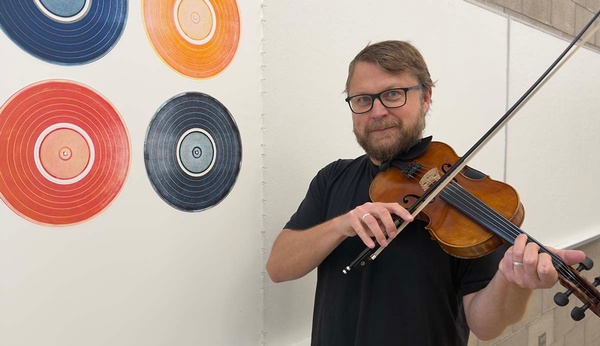
Tony Holmquist
Greetings dear readers! For this week’s “Between the Beats,” I chatted with my dear friend, local musician, artist and Fort Lewis College art professor Tony Holmquist. You’ve seen him with Six Dollar String Band and Tone Dog, and you may have seen his printmaking work at galleries like Studio &. Tony is a world-class printmaker and the kind of musician who quietly influences the Durango bluegrass community. I hope you enjoy a brief snippet of our conversation.
SS: You’ve came to Durango in 2010. What brought you here?
TH: I moved here for a Fort Lewis job. I interviewed in February 2010, and it was my first time in Durango. I was living in Maine, and when I got to Denver, the department chair called and said a big snowstorm was hitting, so I needed to run through the terminal to catch an earlier flight.
I got to the back of the line, and the person in front of me turned around. It was Vince Herman from Leftover Salmon. That was pretty magical. I ended up stuck in Denver for a few days, played tunes with friends, and flew in when the storm ended. There were 4 feet of snow in town.
When I got here, I was holed up at the Strater and would go down to the Diamond Belle. I ended up getting the position, and I’ve been here ever since. I’m going into my 17th year teaching and just received full professor.
SS: Music seems woven into your arrival here, too.
TH: I’d been playing old-time and bluegrass since my late teens, and I’ve always been part of community jams wherever I’ve lived. When I moved here, I started going to the Durango bluegrass jam. I had my friend Jason’s upright bass, and I would put it on a cart and walk it down the river trail.
I think that’s where (you and I) met. You showed up with a bass, and I remember putting mine down and thinking, “Oh good, another bass player.”
SS: You grew up in Nebraska – how were you connected to old-time music?
TH: I had a dear friend in high school, Alex Reeb, who exposed me to so much music. He could play “Terrapin Station” on piano and Slash’s solo from “November Rain.” I didn’t come from a musical or visual arts family, so hearing someone my age play acoustic guitar felt magical.
We started playing bluegrass together. Later, we busked in Santa Cruz, San Francisco and Portland, then drove to Alaska. That’s where I first heard old-time music. A fiddler walked up and played with the fiddle down by his belly. It was raw and rhythmic. I didn’t know what old-time music was yet, but that sound stuck with me.
SS: When did fiddle really become your instrument?
TH: I started around 25, when I was in graduate school at Colorado State. I lived alone in this apartment with thick concrete walls, so I would come home and play fiddle every night and record myself. I wasn’t very good, but it became my favorite instrument because of the expressiveness and creative potential.
A big mentor for me was (obscure Ozark fiddle legend) Billy Mathews. Some friends and I drove out to Arkansas and stayed with him, and he taught us everything. I bought my first fiddle from him, and he taught me about Midwestern music, old-time music, alternate tunings and regional styles.
SS: How do printmaking and music feed each other for you?
TH: There are a lot of overlaps. With printmaking, if you’re printing for yourself, you use both sides of your brain. There’s the creation of the image, where there’s freedom and improvisation. But when you print the plate, it becomes extremely analytical. You’re dealing with paper, ink, pressure, drying time, recipes.
That feels similar to music. There’s improvisation, but there’s also the analytical side of playing an old-time tune in a traditional way. There’s shared language, too. Dissonance exists in color and in music. Rhythm is a design principle. A visual element can repeat and build like sound.
SS: What do you hope comes through in your visual work?
TH: The music connection, abstraction, mark- making and personality. I’d love for my work to have originality, like a signature. I’ve started incorporating photography, especially photographs of musicians.
I’m also interested in bowing patterns. There’s footage of Tommy Jarrell playing fiddle with a little bulb on his bow, and when the lights go down, he’s drawing with the bow. That was mind-blowing to me.
SS: What are you working on now?
TH: I’m printing a large record piece for the KDUR Silent Auction, with multiple color layers, framed by Tom at SmartArt. I’m also showing work at the Houston Public Library on June 6, using (handmade) kozo paper made by Jamie Lee Capps in Minneapolis. The show runs from June 1-July 31. I’m also collaborating with Heinrich Toh from Kansas City on photolithographs, and those will be in the faculty exhibition at Fort Lewis in early September.
-

- An Americana icon
- By Chris Aaland
- 08/31/2023
-
Folk Fest headliner on climate change, indigenous rights and summer road trips
-

- 'Matli crew
- By Chris Aaland
- 06/29/2023
-
Party in the Park returns with Latin rock supergroup
-

- The bottom of the barrel
- By Chris Aaland
- 08/19/2021
-
After 14 years, ‘Top Shelf’ hangs up the pint glass
-

- Back in the groove
- By Chris Aaland
- 07/29/2021
-
Local favorites the Motet return for KSUT’s Party in the Park
- Half a century
-

- 05/26/2022
-
A look back at the blood, sweat and gears as the Iron Horse turns 50
- Bottoms up!
-

- By Stephen Eginoire
- 05/27/2021
-
With this year's runoff more like a slow bleed, it is easy to let one's whitewater guard down. But remember: flips and swims can happen any place at any time.
- Cold comfort
-

- 12/17/2020
-
Seeking solstice solace in the dog days of winter
- A Grand escape
-

- By Stephen Eginoire
- 11/19/2020
-
Pandemic fatigue? Forget the world with three weeks on the Colorado