
Down but not out
'Failed' pop-up bike lane gets bulldozed – and makes the case for itself
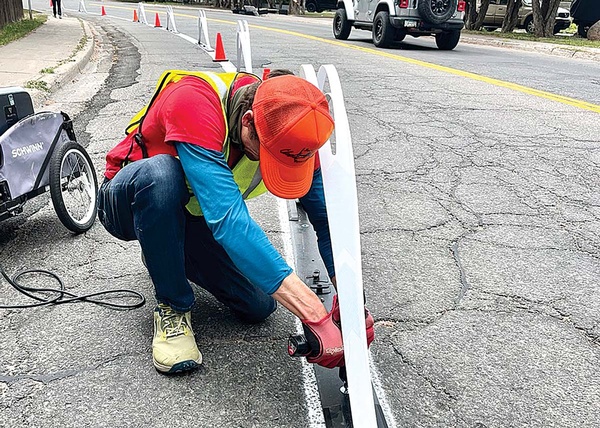
Andrew Allport, co-director of Bike Durango, installs temporary bike lane delineators on Junction Street in early May./ Photo by Jennaye Derge
The most recent data from the National Highway Traffic Safety Administration (NHTSA) reports that 1,166 cyclists were killed by motor vehicles in 2023. According to that same report, an estimated 49,989 cyclists were injured due to a motor vehicle conflict.
According to the CDC and the NHTSA (and every other study), the way to solve this is through roadway engineering and, more specifically, protected bike lanes.
I think about this a lot on my daily commute through Durango’s unprotected bike lanes. I mean, I’m not specifically thinking about numbers and data. But I do think about how close that car just got to me while I was riding on the shoulder of the road, and how I had to slam on my brakes for that other car to turn in front of me. I do often think about the high rates of bicycle-to-motor-vehicle conflict – much of which goes unreported – and I think about how we could drastically lower conflict, injuries, deaths and close calls if we just paid a little attention to bicycle infrastructure.
In other words, if we could just get some damn bike lanes.
Bike Durango co-director Andrew Allport and I have said this so many times that we eventually got tired of saying it and decided to do something about it. In the fall of 2024, Bike Durango assembled a temporary delineated bike lane using a grant from People for Bikes.
There was a wave of support, but the bike lane was also a visual disrupter on the road, so of course, there were some big feelings.
“Another waste of taxpayers money on bicycle sh*t!” wrote “Jim.” He and a handful of others were mostly concerned about the parking spots being taken away and why do us taxpayers have to pay for it. (The bike lane, which spanned one block for one week, was paid for 100% by our grant).
A gal from Bayfield threatened to run the bike lane over with her truck. Folks demanded cyclists pay registration fees. I logged off the internet for a while.
Call it delusional or optimistic, but one year after we built that first pop-up bike lane in downtown Durango, we decided to build another one. This time, using a grant from AARP, we built a delineated bike lane on Junction Street, between W. 2nd Ave. and Miller Middle School. Our plan was to build the lane on the north side of Junction and up that dreaded hill with the blind curve and terrible sidewalk, because it is one of the more dangerous stretches of road for cyclists and pedestrians, and also – we should all truly be ashamed of this – leads to a middle school. This particularly dicey artery, where speed is also a huge problem, also leads to a retirement home and numerous recreation sites, including the Colorado Trail.
Of course, we hit some potholes (literally and figuratively) trying to get permission to place 40 plastic delineators on Junction Street. Andrew had to fight a lot of “no’s,” or “maybes.” But, when he hears “no” he asks “why not?” and then pivots. Eventually, on the blustery day of May 6, we along with a group of volunteers popped up the delineators, drilled them into the pavement and screwed in the “bike lane” signs. During all this we also had a few tense conversations with passersby about what the heck we were doing or how the snow plows will plow.
Six hours later, we finished the lane. We gave each other a high five, and 30 minutes later, a car ran over and broke one of the delineators. It took about three days for enough of the delineators to be run over by cars to fuel concern.
“This project is a failure.” I read from the comment section of our social media.
We had planned to keep the bike lane up for two months, but by May 26, three weeks after we installed it, all but four of the 40 delineators had been hit.
“Should we wear black and have a funeral?” I texted Andrew.
It was unfortunate that our (pricey) delineators were run over, but it actually proved our point: that drivers are not paying attention and are driving into the bike lane. If they can’t avoid hitting a large, stationary object, what’s to stop them from hitting a kid biking to school?
I hate that my point was being proven in real time. But maybe with this evidence, we can present our case more effectively; we can show city officials we need protected lanes, and that crumbling shoulders or sharrows aren’t the answer. We will be better equipped to have conversations with skeptics and, hopefully, find answers to how the snowplows will plow the bike lanes. And, most importantly, maybe we can find ways to build better infrastructure that will keep all road users safe.
So, while the delineators were run over, it was not a failed project. And if I know Bike Durango, I know we’ll probably shake it off and keep trying until something sticks.
-

- An Americana icon
- By Chris Aaland
- 08/31/2023
-
Folk Fest headliner on climate change, indigenous rights and summer road trips
-

- 'Matli crew
- By Chris Aaland
- 06/29/2023
-
Party in the Park returns with Latin rock supergroup
-

- The bottom of the barrel
- By Chris Aaland
- 08/19/2021
-
After 14 years, ‘Top Shelf’ hangs up the pint glass
-

- Back in the groove
- By Chris Aaland
- 07/29/2021
-
Local favorites the Motet return for KSUT’s Party in the Park
- Half a century
-

- 05/26/2022
-
A look back at the blood, sweat and gears as the Iron Horse turns 50
- Bottoms up!
-

- By Stephen Eginoire
- 05/27/2021
-
With this year's runoff more like a slow bleed, it is easy to let one's whitewater guard down. But remember: flips and swims can happen any place at any time.
- Cold comfort
-

- 12/17/2020
-
Seeking solstice solace in the dog days of winter
- A Grand escape
-

- By Stephen Eginoire
- 11/19/2020
-
Pandemic fatigue? Forget the world with three weeks on the Colorado