
Superfund roadtrip
Local group leads citizens – and one intrepid reporter – on mine site tour
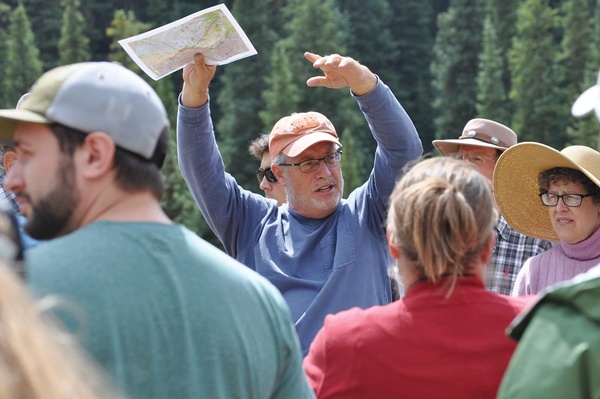
Peter Butler, center, talks to the group about the web of mine tunnels in the Gladstone area. The intricate network of mine shafts and underground waterways make cleanup and remediation challenging.
On a clear, slightly chilly, Saturday morning, a group of about 30 people – including locals, environmentalists, students, professors, politicians, and this reporter – set out on a tour of some of the mine sites included in the Bonita Peak Mining District.
The tour was put together by the Citizens Superfund Workgroup, a newly organized group sponsored by the Animas River Partnership, Animas River Stakeholders Group, Trout Unlimited and the Animas River Community Forum. The idea behind the workgroup is to talk about the area’s mining history, cleanup policy and regulation, water quality and environmental health, and other issues shaping the Bonita Peak Superfund site.
In the end, the workgroup plans to put together a list of citizen recommendations for the Environmental Protection Agency as it begins the process of cleaning up the draining mines and mine waste impacting the health of the Animas River.
 Steve Fearn, who actually owned the Gold King at one point, has been involved with mining and remediation around Silverton since the 1970s./ Photos by Tracy Chamberlin |
Heading up the tour were co-coordinators for the Animas River Stakeholders Group, Peter Butler and Steve Fearn. Both were involved in the founding of the ARSG in 1994 and have been dealing with mine cleanup and remediation in the area for decades.
Early on, Butler explained how the town of Silverton sits on an ancient caldera, a collapsed volcanic crater. Long ago, the volcano carried metals and other material up from the Earth’s mantle, depositing it on the surface, and people have been trying to extract those metals for more than a hundred years.
Butler said there’s a distinct difference between the lands outside the caldera and those within it. The town’s primary source of drinking water, for example, is Bear Creek, in which clean and clear water flows just outside the caldera. Within the caldera are other sites like Cement Creek – now forever linked with the Gold King Mine spill – where iron stains the banks in a burnt-orange hue.
Although the shades are striking and unmistakable, they are not indicators of river health. The true measure of a healthy watershed is aquatic life – which makes the mystery at Mineral Creek, another Animas tributary to the west of Cement Creek, even more amazing.
Mystery at Mineral Creek
The first stop on our tour was a spot northwest of town near Red Mountain Pass where we checked out three mine sites included in the Superfund site: Koehler, Junction and Longfellow.
Back in the mid-1990s, when the Animas River Stakeholders Group first started to catalog all the mines around Silverton, the Koehler Mine, located near Upper Mineral Creek, was the largest single source of metals in the region. Butler called the area nasty, and said there was no way fish could’ve inhabited that stretch of water.
Over the next decade and a half, the ARSG, Sunnyside Gold Corp. and other private companies worked on a total of 12 remediation projects in the area, including the installation of a bulkhead at Koehler and the removal of a nearby tailings pile.
Today, not only have the pH levels and metal concentrations in the area improved, but life has returned to Upper Mineral Creek. Brook trout, which are more resilient than cutthroat trout, were recently discovered, much to the surprise of Butler and his colleagues. They aren’t exactly sure how the fish got there, but one thing’s for sure, the remediation efforts in the area have made a difference.
At the source
For the latter part of the morning, the group took the dirt roads northeast of town toward the Mayflower Mill and its nearby tailings ponds. Made from the mill’s mining leftovers, each of these enormous piles of waste is another site on the EPA’s list.
A little farther up the road is Howardsville, which sits like a shadow of a small mining town overlooking the site of even more mine waste and tailings.
Both of these stops were opportunities to learn that pollution from past mining essentially comes from one of two sources – draining mines and mine waste. Both have their own problems when it comes to clean up and remediation.
Butler said mine waste can be easier to deal with because we know exactly where it’s located. Draining mines, on the other hand, are more challenging.
Seal the mine shaft with a bulkhead or cut off the mine in another way, and it may only force the drainage into the next available crack, crevice or underground cavity. There’s also the option of treating all the drainage, but that process is very expensive.
Fearn, who once owned the Gold King Mine, said every site is different. There is no one-size-fits-all solution for remediation, and funding is always an issue.
As tangled and twisted as the labyrinth of mine workings is, the legal side of Superfunds is actually more so. In most Superfund sites, a lot of money is spent on litigation. The hope for Bonita Peak is that more money will go into the ground than into the lawyers’ wallets.
Monster bags of sludge
After lunch, the group headed up to the Gladstone area, which encompasses the Mogul, American Tunnel, Red and Bonita, and the Gold King mine sites. These four are, by far, the biggest polluters of the Animas River basin.
The tour stopped at the treatment plant now processing drainage coming out of the Gold King Mine, which is still leaking hundreds of gallons of mine waste per minute. The wastewater, along with lime, is pumped into gigantic bags designed to allow the water to slowly leach out while the metals and other materials, which attach to the lime, remain.
In the end, only a burnt orange sludge is left. An excavator then rips open the bags of sludge and slops it into an awaiting dump truck, which hauls it up the hill to be laid out to dry. Layer upon layer, piles of mine waste are slowly building up around the plant.
Currently, there’s no long-term plan for the waste; it’s one of many decisions yet to be made by EPA officials.
Many residents and members of the tour group believe whatever they decide to do, the Gladstone area needs to be dealt with. If those four mines are addressed, it would make a huge impact on the health of the entire Animas River.
And one day, another mysterious school of fish might even show up in the unlikeliest of places.
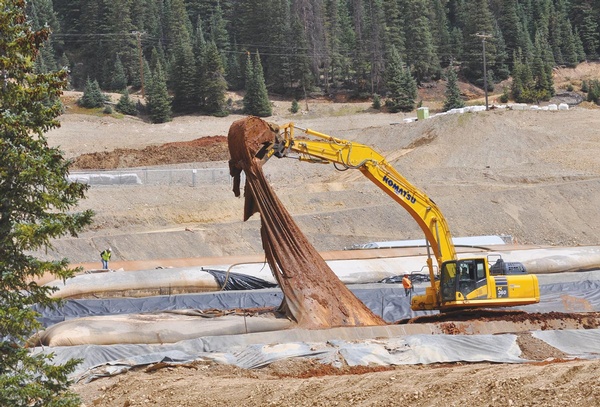
The processing bags at the Gold King treatment plant are ripped open by an excavator. The sludge is laid out to dry, and layer upon layer of mine waste builds up around the plant.