
Forest for the trees
The push is on to strip big trees, protections from our public lands
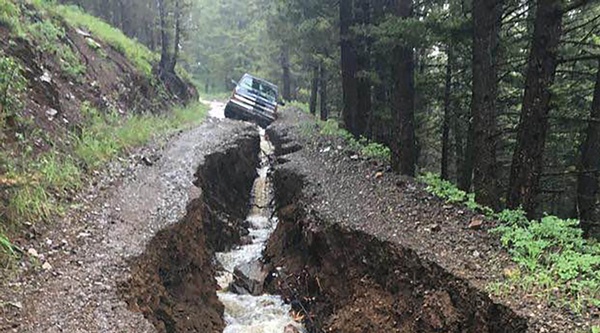
A new directive by the Trump administration to increase and outsource logging on national forests could result in more wildfires and environmental degradation, like this rutted-out old logging road on national forest in Montana./ Photo courtesy Greg Munther
It didn’t get much notice, but President Trump has turbocharged logging on public lands in ways that are likely to increase dangerous wildfire. Inside the “Big Beautiful Bill” that became law this summer, a provision directs the U. S. Forest Service to annually increase the timber it sells until the amount almost doubles to 5 million board-feet by 2032.
Why did few people notice this directive to dramatically increase logging on our public lands? One answer is that it got lost as an engaged public fought selling off millions of acres of public land. Final score: We got to keep the land but not the trees.
Most people support careful logging as part of the smart management of public forests. For instance, a now-irrelevant bill called the “Fix Our Forests Act” had been steadily advancing through Congress, gathering support from both the timber industry and dozens of green groups, ranging from The Nature Conservancy to the Citizens Climate Lobby. By targeting over-abundant small trees while leaving the hardy big ones, that bill would have increased logging while protecting habitat and reducing wildfire.
Trump’s new law eliminates those protections, freeing loggers to cut big trees and leave behind the small ones. This will worsen existing tinderbox conditions, particularly in the West.
The law also essentially outsources some public forest management to corporations. It directs the Forest Service and Bureau of Land Management to develop at least 45 separate, 20-year contracts with private companies. The contracts would enable companies to log across whole districts – not yet determined – or even entire national forests.
Broad approaches like this have a sordid history of inefficiency, waste and environmental destruction. For example, the Skokomish River on Washington’s Olympic Peninsula suffered decades of damaging floods as a result of the sweeping contract one company had for the so-called Shelton Sustained Yield Unit. That sweetheart deal created many bare, flood-prone hillsides and lasted from 1946-2022.
Perhaps it’s surprising, but even timber interests oppose 20-year contracts. More than 70 logging-related businesses sent a letter sent to the Forest Service, pointing out that by allowing a single company to tie up publicly owned timber in a national forest, “long-term contracts would harm competition, markets and prices.”
Why didn’t industry opposition get heard? One theory is that these contracts can serve as a fig leaf masking the consequences of Trump’s high tariffs on Canadian lumber. As tariffs on Canadian timber raise homebuilding costs, the administration can claim to be offsetting the problem by providing cheaper logs from national forests.
In the meantime, the Forest Service is scrambling to meet an onslaught of new Trump executive orders. In June, Secretary of Agriculture Brooke Rollins rescinded “seven agency-specific regulations” that resulted in a 66% reduction of mostly environmental reviews that will offer little opportunity for public comment.
Last week, Rollins also announced her intent to roll back the 2001 Roadless Area Protection Rule, which protects 60 million acres of wildlands. Until Sept. 19, the U.S. Forest Service is taking public comments for a sped-up study on the environmental impacts of rescinding the roadless rule. Fierce legal and political fights are to preserve the rule are all but guaranteed.
All this amounts to a lot of change for an agency ravaged by Elon Musk’s crew of cost-cutters. Some national forests here in Washington State have lost more than a third of their professional staff, while regional offices may be eliminated entirely. Gone are the many experts who had the experience to plan quality timber projects that respect fish and wildlife and reduce wildfire risk.
Will Trump succeed in near doubling the cut from our public forests? Based on my 40 years in the field, I predict the outcome will be a modest increase – but at the high cost of a severe reduction of best practices. That means our national forests, streams and wildlife will suffer as dry fuels keep building up.
I see more big wildfires in our future.
Mitch Friedman is a contributor to Writers on the Range, writersontherange.org, an independent nonprofit spurring lively conversation about the West. He heads Seattle-based Conservation Northwest, which he founded in 1989 after years with Earth First! He is the author of “Conservation Confidential: A Wild Path to a Less Polarizing and More Effective Activism.”
-
- 05/28/2026
- Quick 'n' Dirty
- By Missy Votel
-
Help for the Demon Bridge, Highway 550 N closure, and fire mitigation falls off
- Read More
-

- 05/28/2026
- Getting crafty
- By Haylee May / Colorado Public Radio
-
Colorado brewers buck national trend by adapting to changing times
- Read More
-

- 05/21/2026
- Taming the ART
- By Missy Votel
-
City chooses education, striping over speed limit on River Trail
- Read More
-

- 05/21/2026
- Planned Parenthood reopens
-
PPRM president credits local community in getting clinic running again
- Read More
- Short legs, big party
- 05/28/2026
-
On most days, Tracy Harwood spends her time as a court clerk for the City of Durango. But next Thurs., June 4 – International Corgi Day – she hopes to bring something entirely different to town: short legs, wiggly butts and oversized personalities.
- River cowboy
- 05/21/2026
-
It’s a mash-up made in Westernwear heaven. Sort of. Seems Chaco, the purveyor of the iconic strappy dirtbag river rat footwear, has joined forces with Wrangler, as in tight jeans, big belt buckles, bull riding and snap shirt fame.
- Making plans
- 05/14/2026
-
Wondering what’s up with the old 9-R Admin building at the end of E. 2nd Avenue that was going to be a fire department, then wasn’t going to be a fire department and is now going to be City Hall and the Police Department?The City of Durango will demystify plans for the historic building during a public session Wed., May 20, 5:30-7:30 p.m. at the Durango Recreation Center.
- Going for the gold
- 04/30/2026
-
Turns out, blondes do have more fun, or at least they get more awards. Last week, Ska Brewing won the gold medal for its True Blonde Ale in the English-Style Pale Ale category at the 2026 World Beer Cup. This is the third win for the Blonde at the World Beer Cup, held in Philadelphia on April 22 and pegged as one of the world’s most prestigious beer competitions.