
Missing the stoke
Lack of runoff doesn't just hurt landscapes and livelihoods but recreational bonds
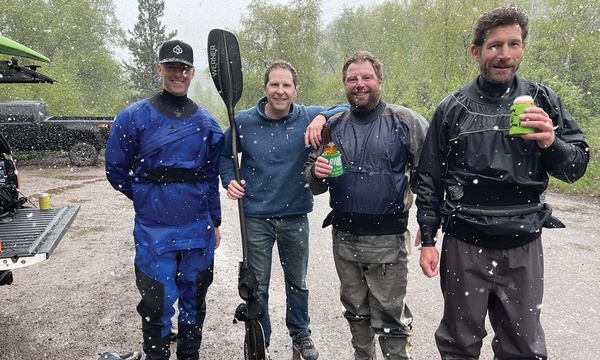
Auden Schendler, far right, celebrates with his paddling crew after a successful but presumably cold mission on their hometown run on the Roaring Fork River./ Photo courtesy Auden Schendler
At this time of year in Western Colorado, my friends and I watch rivers, eagerly anticipating a bruising spring runoff and the start of kayak season. When it arrives, many of us become obsessive, meeting daily after work to paddle.
Not this year. In one of the driest springs in Colorado history, our watershed’s snowpack was 26% of normal on April 1. The impact on fire danger, drought, agriculture, economy and ecology is going to be profound.
But this is the new normal in a climate-changed world. Colorado has warmed 2.3° F since only 1980. The Upper Colorado River Basin suffered close to record-low precipitation in March – normally our snowiest month – and record heat. Snowpack peaked at the earliest date and lowest amount ever. This collapsed the ski industry, and many resorts closed in what is typically their most profitable month.
The kayak run my friends and I like best is called, ominously, “Slaughterhouse.” It flows through an alpine forest at 7,000 feet, near the town of Woody Creek. Kayakers must navigate tight channels and churning holes, steering around boulders the size of VW buses.
Though many of us have kayaked this stretch hundreds of times, we never paddle the same river twice, to echo Heraclitus, because flows are always minutely different, as is the turbidity of the water and the quality of sun or clouds. At the same time, there is a Zen to the repetitiveness: a remembered left turn below a spruce tree to hit an eddy; a crucial line that splits two rocks; the plant smells we recall from last year and the previous 30.
This friend group of men in their forties and fifties – a photographer, a paramedic, a ski mountain manager, a caterer – has become attuned to the river. We continuously observe snowpack and storm cycles throughout winter, with an eye to runoff. We know that when it reaches 500 cubic feet per second (cfs) we can float Slaughterhouse for the first time. Eight hundred to 1,000 cfs is juicy, a joyous party, and that level often holds steady for many weeks. The water gets pushy around 1,300 cfs, and some of us stop paddling when it gets too scary. No need to worry this spring: Slaughterhouse, which can peak above 7,000 cfs, topped out at about 250 cfs.
We know each other like we do the river. Banter focuses on making fun of our paddling. One meme of an upside-down kayak shared on a group chat read: “Roses are red, violets are blue, I lied about having a solid roll … where are you?” If you do happen to swim out of your boat, the group instantly switches from a bunch of jerks to a coordinated rescue team. Expect to hear “Are you doing OK?” for the rest of the day.
Later, expect to be made fun of at that location for the rest of your life. When we gather at the takeout, we drink beer and reflect on our glories and failures, loitering past dinnertime.
To be a good kayaker, you have to be willing to suffer the consequences of a mistake. Typically, that means being upside down in cold water, unable to breathe or see. Boaters call this underwater experience “the white room,” or “being Maytagged.” You accept the fact of an inevitable frigid swim, because, as old kayakers say, “We’re all between swims.” This season, the mistake we must endure is a societal one.
In a sense, kayakers are prepared for the hot, smoky summer ahead: We’ve learned to endure some inevitable pain.; harder to manage will be the loss. We’ll have to forgo the camaraderie, ritual and traditions that come from decades of recreation tied to seasons, place and environment. The truth is, as the planet warms, we’re in danger of losing a sense of who we are.
Philosopher Glenn Albrecht coined a term for this: solastalgia, the distress caused by environmental change, creating a “homesickness you feel while still at home.”
It is widely understood that climate change will forever alter our physical world. Indeed, it already has. It’s less obvious that it’s also coming for our friendships, our identity and the spirit and rhythm of our lives.
Auden Schendler is a contributor to Writers on the Range, writersontherange.org, an independent nonprofit dedicated to spurring lively conversation about the West. He lives in Basalt and is the author of “Terrible Beauty: Reckoning with Climate Complicity and Rediscovering Our Soul.”
-
- 05/28/2026
- Quick 'n' Dirty
- By Missy Votel
-
Help for the Demon Bridge, Highway 550 N closure, and fire mitigation falls off
- Read More
-
- 05/28/2026
- Getting crafty
- By Haylee May / Colorado Public Radio
-
Colorado brewers buck national trend by adapting to changing times
- Read More
-

- 05/21/2026
- Taming the ART
- By Missy Votel
-
City chooses education, striping over speed limit on River Trail
- Read More
-

- 05/21/2026
- Planned Parenthood reopens
-
PPRM president credits local community in getting clinic running again
- Read More
- Short legs, big party
- 05/28/2026
-
On most days, Tracy Harwood spends her time as a court clerk for the City of Durango. But next Thurs., June 4 – International Corgi Day – she hopes to bring something entirely different to town: short legs, wiggly butts and oversized personalities.
- River cowboy
- 05/21/2026
-
It’s a mash-up made in Westernwear heaven. Sort of. Seems Chaco, the purveyor of the iconic strappy dirtbag river rat footwear, has joined forces with Wrangler, as in tight jeans, big belt buckles, bull riding and snap shirt fame.
- Making plans
- 05/14/2026
-
Wondering what’s up with the old 9-R Admin building at the end of E. 2nd Avenue that was going to be a fire department, then wasn’t going to be a fire department and is now going to be City Hall and the Police Department?The City of Durango will demystify plans for the historic building during a public session Wed., May 20, 5:30-7:30 p.m. at the Durango Recreation Center.
- Going for the gold
- 04/30/2026
-
Turns out, blondes do have more fun, or at least they get more awards. Last week, Ska Brewing won the gold medal for its True Blonde Ale in the English-Style Pale Ale category at the 2026 World Beer Cup. This is the third win for the Blonde at the World Beer Cup, held in Philadelphia on April 22 and pegged as one of the world’s most prestigious beer competitions.