
Where the buffalo roam
Wild bison deserve better treatment from Montana lawmakers
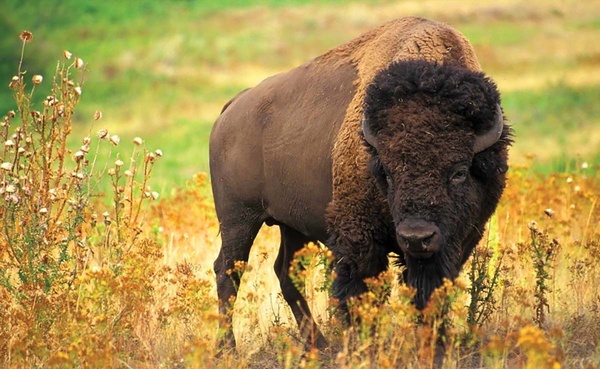
The last Great Plains wild buffalo was killed in 1886, but over the last 50 years, state, federal and tribal efforts have restored the native species to reservation lands. However, recent actions by Montana to roll back reintroductions and protections could threaten that./ Photo by Jack Dykinga, U.S. Department of Agriculture
In 1886, the last wild buffalo on the Great Plains was killed among the steep bluffs and badlands of central Montana, the final remnant of the tens of millions of bison that once roamed the nation’s vast prairies.
The slaughter of the buffalo was a tragedy for all Western Indian tribes – including every tribe in Montana – because the animals were everything to Native people. Bison provided food, shelter, clothing and tools. They were central to spiritual practices. Their destruction was also a central part of the federal campaign to subdue and dispossess tribal nations.
But before the last smoke from the buffalo guns had cleared, Native visionaries had acted. A Salish man known as Attice trailed a few surviving bison across the Continental Divide to Montana’s Flathead Valley. That small herd would become critical seedstock for rebuilding bison herds in both the United States and Canada.
Through Attice’s efforts, state and federal agencies across the West were later able to establish small herds on refuges and wildlife management areas. Over the last 50 years, Western tribes have also led determined efforts to restore buffalo on reservation lands.
Tribes have also benefited from partnerships with conservation organizations that share a vision of big, healthy bison herds grazing across large landscapes. Chief among these partners is American Prairie, which for the past 25 years has worked to restore intact grasslands on public and private lands adjacent to Montana’s Charles M. Russell National Wildlife Refuge. As part of its work, American Prairie has also provided both technical expertise and buffalo to many tribal nations rebuilding their herds.
Yet even with these initiatives, there are only a few thousand truly wild buffalo today, and they occupy just a tiny fraction of their former range across the American and Canadian prairies. Why?
The persecution of bison continues – nowhere more so than in Montana. Gov. Greg Gianforte’s administration has opposed any expansion of wild buffalo populations and has relentlessly pressured the Bureau of Land Management to reverse earlier, positive bison decisions.
Bowing to this pressure, the BLM has denied a request by American Prairie to convert existing federal grazing permits from cattle to bison in eastern Montana. What’s worse, the BLM has terminated other bison grazing permits that the organization had lawfully held for years.
Given the stakes, the Coalition of Large Tribes – advocating for more than 50 tribal nations, including the Blackfeet Nation and the Fort Belknap Indian Community in Montana – has filed a formal protest of the BLM’s unprecedented and unlawful decision. Federal law is clear: statutes affecting tribes must be interpreted in their favor and ambiguities must be resolved to protect tribal rights.
The consequences of the BLM’s illegal action are immediate and profound. Terminating these permits disrupts herd genetics, intertribal gifting traditions, treaty territories and longstanding cooperative relationships. It also establishes a dangerous precedent for other federal agencies engaged in tribal co-stewardship and wildlife restoration, not only for Montana tribes but for tribes everywhere. If bison being managed for conservation can be categorically excluded from federal lands, decades of collaborative progress are jeopardized.
Perhaps most alarming, this decision amounts to rulemaking by fiat. In order to reach the result demanded by the Gianforte administration, the BLM acted without meaningful consultation with either tribes or the public.
Federal law is clear. Actions and decisions affecting tribes require consultation, yet no meaningful effort has been made by either the BLM or the Gianforte administration to fulfill this binding obligation. If this failure to consult is allowed to stand, tribes across the West will be harmed by the precedent.
Montana and the federal government face a defining choice: They can cling to outdated policies that ignore history, science and treaty obligations, or they can honor tribal leadership, uphold the law and help restore a species that once defined this land.
The future of Montana’s prairies depends on that choice.
The writers are Montana state legislators and contributors to Writers on the Range, writersontherange.org, an independent nonprofit dedicated to spurring lively conversation about the West. Tyson Running Wolf is a member of the Blackfeet Nation who chairs the Montana Native American Caucus in the Montana Legislature. Tom France represents Missoula in the Montana Legislature and works with the Rocky Mountain Tribal Leaders Council on buffalo conservation issues.
-
- 05/28/2026
- Quick 'n' Dirty
- By Missy Votel
-
Help for the Demon Bridge, Highway 550 N closure, and fire mitigation falls off
- Read More
-

- 05/28/2026
- Getting crafty
- By Haylee May / Colorado Public Radio
-
Colorado brewers buck national trend by adapting to changing times
- Read More
-

- 05/21/2026
- Taming the ART
- By Missy Votel
-
City chooses education, striping over speed limit on River Trail
- Read More
-

- 05/21/2026
- Planned Parenthood reopens
-
PPRM president credits local community in getting clinic running again
- Read More
- Short legs, big party
- 05/28/2026
-
On most days, Tracy Harwood spends her time as a court clerk for the City of Durango. But next Thurs., June 4 – International Corgi Day – she hopes to bring something entirely different to town: short legs, wiggly butts and oversized personalities.
- River cowboy
- 05/21/2026
-
It’s a mash-up made in Westernwear heaven. Sort of. Seems Chaco, the purveyor of the iconic strappy dirtbag river rat footwear, has joined forces with Wrangler, as in tight jeans, big belt buckles, bull riding and snap shirt fame.
- Making plans
- 05/14/2026
-
Wondering what’s up with the old 9-R Admin building at the end of E. 2nd Avenue that was going to be a fire department, then wasn’t going to be a fire department and is now going to be City Hall and the Police Department?The City of Durango will demystify plans for the historic building during a public session Wed., May 20, 5:30-7:30 p.m. at the Durango Recreation Center.
- Going for the gold
- 04/30/2026
-
Turns out, blondes do have more fun, or at least they get more awards. Last week, Ska Brewing won the gold medal for its True Blonde Ale in the English-Style Pale Ale category at the 2026 World Beer Cup. This is the third win for the Blonde at the World Beer Cup, held in Philadelphia on April 22 and pegged as one of the world’s most prestigious beer competitions.