Bookends for a life
David Feela - 08/21/2025Born Jan. 17, 1914 – died Aug. 28, 1993. Like bookends, his life supported many people’s reading and writing lives, including mine. He still does. Every August I revive this memory of a poet and pacifist who published 51 books in the span of his 79 years. William Stafford lived a literary life, but he was also a man who refused to occupy a literary pulpit. He demonstrated a quieter way, a daily ritual of writing that produced not only a legacy of remarkable poems but also a way to think about the creative process.
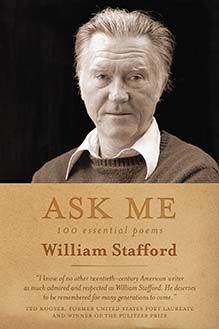 The poems themselves – often short – focused on simple local details that were unusually accessible, relying on the power of speech. What’s amazing about Stafford’s poems is that the language is far from ordinary, for he captures the nuances of phrase and image. A professor at Lewis & Clark College and teacher on the campus known as Earth, Stafford touched as many lives in his travels as he did through his writing.
I had known Stafford for more than 20 years before I met him – known him in the way a reader comes to know an author, holding his ideas in my hands, fearing his physical self somehow incapable of standing beside his work. We were, strangely enough, introduced by a series of coincidences but stood face to face only once. It seemed afterward as if some great design in the universe continually suggested we meet.
I never vigorously sought Stafford’s counsel through his books, but it didn’t matter – his writing continued to materialize in an astounding number of publications. As a creative writing student in the 1970s, it was impossible for me to pick up an anthology or little magazine without encountering one of his poems. As he told me much later, he submitted more material in the mail than anyone could possibly imagine; he dryly suggested that he’d flooded the market
Stafford surfaced again in 1983 – still in print – but revealing for me more of the man behind the writing. It was a thin, prose volume in a thrift store with the name William E. Stafford on the cover. “Down in My Heart” was a book title I didn’t recognize, but I paid one whole dollar on the hunch it might be related to William Stafford, the poet. To my surprise, Stafford was writing about his commitment to peace as a conscientious objector during World War II. Years later, Stafford told me the edition was probably worth $200 but that he (winking) would never pay such a price. He signed it for me, “William Stafford, April, 1988” – exactly 40 years after it had been published as his Master’s thesis.
I noticed in a newspaper that William Stafford scheduled a reading and workshop in Cedar City, Utah, so my wife generously agreed to a motorcycle trip on a long and tedious day for the chance to meet up.
Our evening with Stafford was too short. I talked with him about a half hour. He laughed when Pam told him he is my hero. He said he’d have to be sure to tell his wife, and that she’d be surprised to know her husband inspired such devotion from a couple of strangers who’d suffered a motorcycle for 10 hours just to say hello.
I told him about how often I encountered his writing and the events that led us to find him. He laughed, suggesting that he was the one who was lucky to have planned Cedar City into his summer. We talked. I don’t even remember what we could have discussed. It couldn’t have amounted to much, but we shared that moment. It actually seemed to mean as much to him as it did to me.
The poem I remember most from that night stays with me. I know it by heart, and even though we will never sit in the front row and listen to him recite it again, I’ll leave it here, like a message in a bottle, for someone else to discover.
“Ask Me”
Some time when the river is ice ask me
mistakes I have made. Ask me whether
what I have done is my life. Others
have come in their slow way into
my thought, and some have tried to help
or to hurt: ask me what difference
their strongest love or hate has made.
I will listen to what you say.
You and I can turn and look
at the silent river and wait. We know
the current is there, hidden; and there
are comings and goings from miles away
that hold the stillness exactly before us.
What the river says, that is what I say.
Just plain-spoken William Stafford, more like the “Bill” he inscribed in a book that surprised me once in the mail. “For David, Remember when we met?” – as if to remind me of an event he treasured, as if I could ever forget.
– David Feela
-
- 05/28/2026
- Cup of memories
- By Kirbie Bennett
-
Navajo tea serves as both comfort and cultural tether to ancestors
- Read More
-

- 05/21/2026
- Half man, half marathon
- By Zach Hively
-
A reluctant runner confronts middle age, tight pants and self-improvement
- Read More