Signs of the times
Spring brings not only warmer temperatures but also dandelions, those little yellow badges popping up on the lawn where bees arrive and stop to share their opinions about the weather, not so different from our own election seasons when campaign signs pop up across our neighborhoods. But the bees don’t pay much attention when it comes to the political climate.
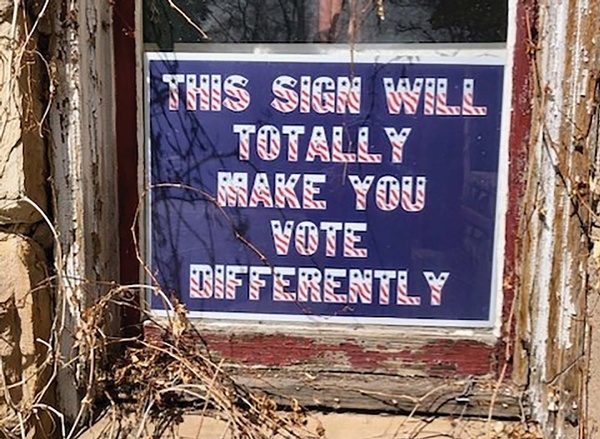
Walking down Durango’s historic 3rd Avenue, I spotted a most curious sign in a window, possibly a student housing residence. I had to smile, because it reminded me of my own college days, renting various rooms in a variety of subdued landmark structures still standing like scarecrows in the midst of the more elaborately restored private homes.
A sparkly red, white and blue poster in all CAPS spelled out “This sign will totally make you vote differently.” I had to stop and take a picture. At first, I wasn’t sure I understood what it intended to say, but I continued to ponder what it had to say while walking down the street. Aside from its patriotic colors, the poster didn’t actually endorse any political party or candidate. Could the resident who hung it in the window be confused? Not likely, and that’s when I got it, like totally!
Traditional political candidates canvas entire neighborhoods, trying to meet and greet, glad-handing when necessary, working to break through to any undecided or bewildered voters who maybe don’t recognize the individual or even care who is asking for their support. Just like the old lightbulb jokes, I wondered how many doorsteps it takes to win an election? My answer would be none. People vote on ballots.
During these days of political intimidation, I suspect many voters avoid answering the door without first glancing at the door-cam or peeking through a curtain. Even the candidates must be a little hesitant to knock. Like dust devils, incendiary rhetoric creates its own inhospitable climate. Admittedly, some voters are like NASCAR or hockey fans. They look forward to the roar of the crowd, and anticipate the inevitable crash-bang-brawl of politics. I prefer a quieter life, enjoying an easy chair and the comfort a softer voice delivers. If I did post campaign signs it would be to aerate my lawn with their wire stands.
This sign will totally make you vote differently suggests, in a tongue-in-cheek manner, the futility of trying to change voters’ minds once they’ve decided it doesn’t matter what anyone else says.
In an effort to briefly explain political signage to the ordinary voter, consider these possible motives to advertise in any race for our democracy’s future.
• Name-recognition: as if a person’s name could tell any passerby anything useful about that particular candidate...
• Personal identity: like, I’m a Republican or I’m a Democrat or I’m one of those crazy Independents, so there...
• Popularity: as if tallying up the name with the most signs could accurately predict the candidate who’s most likely to win
• Subliminal psychology: if you can’t remember all the names by election day you can rely on the sign’s Doppler effect...
• Motives: as if a simple sign might clarify the honesty that a candidate intends to bring to the office ...
• Déjà vu: so, didn’t we just have an election?...
• Post-it marketing: like, this homeowner wants to use these wire thingies for garage sale signs after the election...
• Familiarity: Oh, I think I know who that is, maybe...
Dozens of internet sites sell optional design packages that include the actual signs printed and delivered to your doorstep, some priced as little as 84 cents apiece. I wondered, could just anyone run an imaginary campaign, not even bothering with the registration to appear on a legal election ballot? A grassroots movement for your lawn?
A woman named Cindy Kam, a political lab professor at Vanderbilt University, pondered the same questions. She ran what’s called the “Ben Griffin” experiment, placing two fictitiously named yard-sign contenders on a busy street corner beside a multitude of other legitimate at-large candidates. A survey mailed two days after her study ended revealed a quarter of the respondents chose Ben as one of their top three choices. She concluded, “that in races where little information is available, having some sense of name recognition, having seen (it on) multiple signs that convey a sense of viability (and) electability can be useful.”
Could the name Ben Griffin contain an element of suggestibility the professor hadn’t counted on, something like “been grift’n?” Who knows? My conclusion would have been more concerning, realizing that so many voters treat filling out a ballot as a kind lottery. And what’s the jackpot? In this era of hyper-partisan politics, we actually might vote for what we really don’t want: a name that stands for nothing, or maybe nothing more than rage and grievance.
– David Feela
-
- 05/28/2026
- Cup of memories
- By Kirbie Bennett
-
Navajo tea serves as both comfort and cultural tether to ancestors
- Read More
-
- 05/21/2026
- Half man, half marathon
- By Zach Hively
-
A reluctant runner confronts middle age, tight pants and self-improvement
- Read More