
Another one bites the dust
San Juan Generating Station goes down; energy transition moves forward
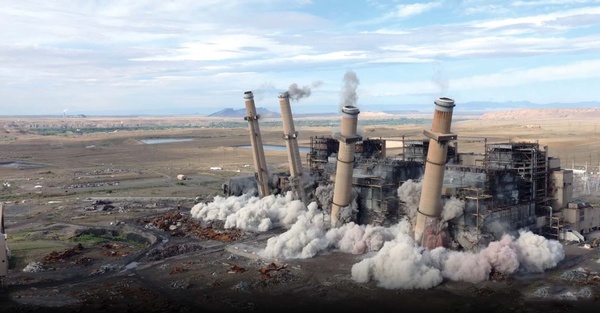
The smokestacks at the now defunct San Juan Generating Station go down in a blaze of glory on Sat., Aug. 24. This was the final resounding death knell for the power plant 15 miles from Farmington, which ceased operation in 2022./ Photo courtesy EcoFlight and Benjamin Hunter
After five decades of spewing sulfur dioxide, ash, mercury, arsenic, carbon dioxide and other pollutants into the Four Corners air, the four stacks of the San Juan Generating Station near Farmington were brought down in spectacular fashion this past weekend. Sadly, I missed it in real life, but even the videos leave me feeling a bit giddy, as the controlled demolition heralds a cleaner, hopefully more just era in the Four Corners.
It’s symbolic, of course: The real action happened in September 2022, when the last of the plant’s four units burned through the final ton of coal and the turbine quit turning for good. But what a symbol it is, for the region and for me, personally: The power plant, and, to an even larger degree, its older, bigger sister plant, Four Corners, have loomed over my existence since I was very young.
Four Corners was constructed in 1964 and was the flagship of a massive effort by a consortium of utilities called WEST, or Western Energy Supply and Transmission Associates. They hoped to construct six massive coal-fired power plants and accompanying mines across the Colorado Plateau, which would ship power hundreds of miles to rapidly growing Los Angeles, San Diego, Las Vegas, Phoenix and Albuquerque across high-voltage lines.
Not only did the growing supply of cheap power – and air-conditioning and water pumping – help the population of the Southwest’s cities soar, but the marketing caused the average American’s electricity consumption to grow four-fold between 1946-68. “We are, in short, on an energy binge,” Harvey Mudd, Director of the Santa Fe-based Central Clearing House told the congressional committee in 1971, “which, like all binges, can only end in disaster.”
Mudd’s warning may even be more timely in 2024, as we embark on a new electricity binge to power the proliferation of energy-hungry AI-processing and cryptocurrency-mining data centers.
Four Corners Power Plant was the first of the six to go online, sprouting up on the edge of the Navajo Nation, atop the Fruitland formation, about 15 miles from Farmington. The relatively sparse population, along with the dearth of environmental regulations, allowed the mine and plant largely to be built under the radar. But once it started churning out juice and pollution – to the tune of over 400 tons of particulate matter per day, along with sulfur dioxide, nitrogen oxides and mercury – no one could miss the behemoth. The facility, along with its smog, became a smoke-spewing symbol of energy colonialism, landscape-scale industrialization and humans’ ability to spoil the environment.
It helped give rise to a regional environmental movement, made up of elected officials, concerned residents and advocates, which protested the pollution and implored a congressional committee in 1971 to block further power plant construction.
But the impassioned rhetoric fell on deaf ears. After Four Corners came Mojave, Navajo Generating Station near Lake Powell, Huntington in Utah, and San Juan Generating Station, just across the river from Four Corners. They all had better pollution controls than Four Corners did initially, but together they still kicked out thousands of tons of pollutants along with tens of millions of tons of planet-warming carbon dioxide each year, leaving the Four Corners to appear as if it had been inundated by a vast sea of smog. Only the largest of all those slated to be built, the 5,000-megawatt Kaipairowitz plant, which would have sat on the western shore of Lake Powell eating up coal from land that was later included in Grand Staircase-Escalante National Monument, was not constructed.
I was born in the midst of the Big Buildup in 1970, and not long after I became conscious of the world around me. I learned that the haze in the air that blotted out the once-expansive views of my homeland was not natural. And I learned that the main culprits were the new coal-burning power plants that loomed over the landscape. It was probably my first understanding of environmental destruction.
A decade and some years later, on a midsummer’s eve, when I was in my late teens or early 20s, I drove my 1967 AMC Rambler station wagon west from my dad’s house in Cortez, over undulating gravel roads past hay fields, with their perfectly cubical hay bales lined up in a row, casting long shadows across the bright green, monsoon-moistened, freshly cut field. I was headed to The Point, atop the McElmo Dome, out beyond the last bean and hay fields. It was a nice place to camp because of its proximity to Cortez, but more importantly because of the views. You could see all the way to Monument Valley and Navajo Mountain – if the air was clear, which was rare.
I didn’t like the smog, but I also didn’t really know anything different, since the smog was there before I was and never really abated, given that the power plants churned round-the-clock, every day of the year. I had resigned myself to it; call it normalized degradation.
After watching the smog-enhanced sunset, punctuated by distant lightning strikes, I lay out my sleeping bag on the sandstone rim and covered it with a tarp and fell asleep. Deep in the night, I was awoken by lightning and thunder and huge raindrops pelting the tarp. I snuggled up underneath and let it lull me back asleep. When I awoke before sunrise, I was startled by the clarity of the air. I not only could see the landforms of Monument Valley and the dark curve of Navajo Mountain, but I could see fissures in the sandstone and canyons on the mountainside. It was truly glorious to watch the sunlight spread across the landscape like that.
But my revery soon was interrupted. A yellowish-gray amoeba, coming from the south, oozed its way up the canyons toward me. It was no mystery. It was smog, rushing in from the Four Corners and San Juan plants to replace the stuff that had been washed out by the night’s heavy rains. A sadness and anger rose up in me, and I think it has lingered ever since, motivating much of what I do.
So it was with a sense of satisfaction that I watched the video of the smokestacks falling into a cloud of their own demise.
The Land Desk is a newsletter from Jonathan P. Thompson, author of “River of Lost Souls,” “Behind the Slickrock Curtain” and “Sagebrush Empire.” To subscribe, go to: www.landdesk.org
-

- 06/04/2026
- Tougher on trash
- By Missy Votel
-
As human-bear conflicts rise, new state law targets ‘knowingly’ allowing attractants
- Read More
-
- 06/04/2026
- Redefining the business of art
- By Parker Yamasaki / The Colorado Sun
-
Colorado’s new A Corp model helps creatives retain control while attracting investment
- Read More
-
- 05/28/2026
- Quick 'n' Dirty
- By Missy Votel
-
Help for the Demon Bridge, Highway 550 N closure, and fire mitigation falls off
- Read More
-

- 05/28/2026
- Getting crafty
- By Haylee May / Colorado Public Radio
-
Colorado brewers buck national trend by adapting to changing times
- Read More
- Getting gassed
- 06/04/2026
-
Gas prices are once again giving America something to complain about. And while the local beer meisters at Ska Brewing can’t fix the price at the pump, the brewery is offering one small bit of relief: a new light beer that costs one cent less than the price of a gallon of unleaded gas.
Introducing Ska’s newest brew: West’s Easy Light Lager, because “everything else is so hard.”
- Short legs, big party
- 05/28/2026
-
On most days, Tracy Harwood spends her time as a court clerk for the City of Durango. But next Thurs., June 4 – International Corgi Day – she hopes to bring something entirely different to town: short legs, wiggly butts and oversized personalities.
- River cowboy
- 05/21/2026
-
It’s a mash-up made in Westernwear heaven. Sort of. Seems Chaco, the purveyor of the iconic strappy dirtbag river rat footwear, has joined forces with Wrangler, as in tight jeans, big belt buckles, bull riding and snap shirt fame.
- Making plans
- 05/14/2026
-
Wondering what’s up with the old 9-R Admin building at the end of E. 2nd Avenue that was going to be a fire department, then wasn’t going to be a fire department and is now going to be City Hall and the Police Department?The City of Durango will demystify plans for the historic building during a public session Wed., May 20, 5:30-7:30 p.m. at the Durango Recreation Center.