
Theory of evolution
On historic preservation, cars and Durango's main drag redesign
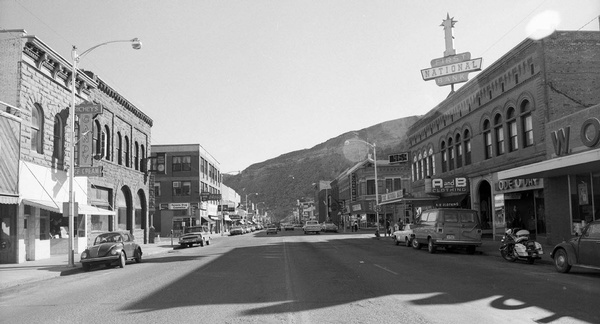
Durango's Main Avenue in 1978, when it was still used as a thoroughfare. Note the lack of trees along the sidewalks and the six lanes for cars (two for parking and four for driving). Though the businesses have mostly changed and the mid-century signs have disappeared, it still looks pretty similar and the street is still very wide.
It has been with some dismay that I’ve read about people stridently opposing Durango’s proposal to make its downtown safer and more pleasant for pedestrians. It’s baffling that such a benign plan – which at its core is widening the sidewalks in places – could generate such vitriol and even fear.
The opponents give all sorts of reasons (I’ll get to those in a minute). But ultimately, the pushback seems to be sparked by a deeply held fear that the automobile’s supremacy will be diminished, as well as an almost primal fear of change. And that is what makes wider sidewalks a universal battle that plays out in many forms across the West.
The proposed redesign would stretch nine blocks along Durango’s Main Avenue. Historically, this was the city’s central business district, lined with hotels, restaurants, bars, banks, gas stations and even a couple department stores. Up until the 1970s it was also the main artery going through town. Travelers wanting to go from, say, Silverton to Farmington would drive down Main Avenue, turn left on 6th Street (now College Drive), and then turn right onto 8th Avenue and State Highway 3.
In the ’60s, Camino del Rio, aka the “Truck Bypass,” was built, routing traffic around downtown, and later the High Bridge was built, firmly establishing Camino del Rio as Durango’s main through-artery. The downtown segment of Main Avenue gradually shed its role as a thoroughfare, the hardware stores and such shifted over to Camino del Rio and, ultimately, out to the big box-land south of town.
But Main Avenue did not shed its thoroughfare design. Which is to say it looks like downtown Delta or Montrose, both of which have major highways running through them. Up until several years ago, there were six lanes for cars: two for parking and four for driving. That now has been reduced to five lanes, with wider parking areas, two driving lanes, and a middle turn/delivery truck lane. That’s an improvement, but still, it’s five lanes on a street that is not a throughway.
So, for more than four decades, residents, business owners and city leaders have worked to make Main Avenue look and feel less like a major highway and more like a business district. In fact, in the early 1980s my father, who was on the City Council, floated the idea of closing a block or two off to cars and converting them into a pedestrian mall. It was shot down, in part because people still thought of Main Avenue as a thoroughfare. And besides, it would totally disrupt the teenagers who liked to cruise Main. More incremental, less disruptive efforts continued, however, some taking hold (such as planting trees), some not.
When COVID hit, and indoor dining became a no-no, the weakness of relatively narrow sidewalks was driven home. There was simply not enough room for restaurants to put tables out front, meaning if they didn’t have a patio in back, they were out of luck. The temporary “bump-outs,” which allowed businesses to put patios in the parking zone, were a hit, and gave a push to long-simmering efforts to redesign Main. That, along with at least three pedestrians being hit by cars, has led to the current “Next Step” proposal that’s stirring up so much ire.
Downtown’s Next Step preferred concept (which is preliminary) would widen the sidewalks with bump-outs near intersections and in the middle of the block on some segments. It would include pedestrian crossing “bulbs” on all corners, and there would be a lot more trees along the sidewalks. And that’s really about it. Every block would still have segments with five lanes for cars, and the delivery/turn lane would remain, meaning there are no segments with fewer than three lanes for cars.
It doesn’t sound that scary to me. But some folks think it would destroy life in Durango. Let’s go through a few of the reasons for opposition:
• The main gripe is with the net loss of parking spaces along Main Ave. Some even imply visitors will go somewhere else if they can’t park directly in front of a specific business.
• Others worry fire trucks or large delivery vehicles won’t be able to navigate around the pedestrian bulbs, and the bulbs will put delivery truck operators at greater risk of being hit by a car.
• One letter to the editor writer asked: “Wider sidewalks, why? They will steer shoppers away from businesses.”
• And then there is the claim that it would diminish the historical character of downtown and even “destroy the integrity of this special place,” as one person put it.
I’ll take these one by one:
• There are currently 1,641 public parking spaces within a five-minute walk of downtown Durango, according to the city. Surveys by the city, along with my own observations, have found that even during the busiest times, there are ample vacant spaces – from 10% to 50% or more – within a couple blocks of Main. The Next Step would eliminate 47 of those spaces, or about 3%, which is about the same that were lost during the COVID bump-outs. It will not, by any stretch, cause a parking shortage. It will mean fewer people jamming up traffic while trying to parallel park on Main, but is that really a bad thing?
• The city says it tested fire trucks on the concept and found that the bulbs could, in fact, be navigated.
• The main danger to delivery truck drivers who park on Main is being hit by a passing car. Narrowing the road will actually slow traffic, reducing danger, not increasing it.
• I don’t think I need to respond to the “wider sidewalks steer folks away from businesses” argument. Come on!
• And, finally, we get to the historical character argument. In a letter to the Durango Herald, Sidny Zink, speaking on behalf of the La Plata County Historical Society, decried Next Step’s potential to destroy Durango’s integrity and jeopardize downtown Durango’s status as a nationally registered Historic District. “It is the intent of the Registry that the Historic District be preserved with the streetscape of the period of the 1880s and ’90s.”
This is where the less restrained would make some snarky comment about there being no cars back in the 1880s, so really we’d need to tear up the asphalt, ban automobiles and bring back the streetcar that ran down the middle of the avenue. Or maybe whether “preserving the streetscape” includes restoring the manure that piled up in the gutters. And what about the thick cloud of coal smoke from homes and the smelter that coated all the buildings with grime and reduced visibility?
But, I’m not like that. So I went back and found the 1980 document nominating the Main Avenue Historic District for the registry. It says the district consists of “104 commercial buildings that collectively reflect the late 19th and early 20th century history and architecture.” Eighty-six of those buildings contribute to the historic integrity, it said, and of those, nine were particularly important.
Nowhere does the document mention streets, parking spaces, sidewalks or streetscapes. That’s because trying to preserve the historical integrity of a streetscape by banning alterations to sidewalks or parking spots is as absurd as depriving the Strater Hotel (one of the nine important buildings) of indoor plumbing in order to maintain its 1880s character. In fact, it didn’t even apply to signs: The same City Council that pushed for the registry listing also passed a strict sign code that phased out all of the gaudy, if historic, signs in town.
Historical preservation is not freezing something in time. Nor is inclusion on a historic register meant to block or prevent change or evolution. And yet, this is exactly what opponents are trying to do.
I was born in Durango 54 years ago and in the ensuing decades have seen a lot of changes, some good, some not so much. Looking through the historic district nomination and the list of structures and businesses in them in 1980, really drives this home. It’s like a deluxe version of the Used-to-Be Game – while most of the buildings remain, only a handful of the establishments have survived.
There’s no more Treasure Tunnel or Francisco’s. The Galloping Goose and the Gold Slipper are gone, as are Alpine Sports, Farquahrts, Woolworths, the Warm Flow (a hippy restaurant with an unappetizing name), Pacesetters, Johnson Jewelry, The Tannery, Landis Shoe Store, Ski Fritz Sports, Mr. Rosewaters, Cat & the Fiddle, Lost Pelican, French Hardware, New York Bakery, JCPenney, Hogans, Coast-to-Coast, Panhandler Pies, Peterson Office Supply, Penningtons, Model Tire Store, Stuart’s… and I could go on.
Reading this list makes me a bit sad, because it reminds me of my childhood and how far behind me it is, and it also reminds me how much has changed in my hometown. Most of the functional, practical stores – places to get a pair of Levis, a new suit or your shoes repaired – have vanished, replaced by big boxes out on the fringe, real estate offices, tourist shops and upscale eateries. The 1980s-era character has changed dramatically (as can be expected), even as the architecture and the “streetscape” has remained relatively unchanged.
When Durango old-timers push back on progressive initiatives like the Next Step or the town acquiring open space, establishing new parks, building boat ramps or extending the Animas River Trail, I don’t think they’re actually worried about historical integrity. They are actually afraid of another kind of change, one that’s more fundamental and cultural. And to some degree, the fear is justified: If you do things to improve quality of life, it’s going to make that place more appealing to non-residents, who will then move in, buy property and drive up prices. That, in turn, will push out the less wealthy people and the less profitable businesses. Newcomers will make their own “improvements,” leading to a sort of gentrification feedback loop.
That sucks. But you’re not going to stop it by trying to lock downtown into place. A community can’t block these sorts of changes, and attempting to do so by shooting down quality-of-life initiatives is futile. A community has to accept the changes while mitigating their negative effects, which can be done by expanding public transit, improving pedestrian and bicycling infrastructure (to render those parking spaces obsolete), building affordable housing, buying locally, supporting the arts and raising wages.
Durangotans can lament the changes, while also celebrating them. They can enjoy the Animas River Trail and all the great singletrack and tasty new restaurants, even though they may have contributed indirectly to the breakneck growth and housing crisis. They can take heart in the fact that some of those downtown businesses survive and even thrive: Gardenswartz, Maria’s Bookshop and Mountain Bike Specialists, to name a few. You can still get a haircut at Tucson’s, a beer at the El Rancho and some green chile at the Diner. And if the Next Step ever happens, you can even enjoy those things out on one of the bump-outs.
In the 1980 national register nomination form, the author wrote: “The Main Avenue Historic District in Durango is significant because it represents the essence and core of both the evolution and development of business and commerce in the most important town in Southwestern Colorado.” The key word? Evolution.
The Land Desk is a newsletter from Jonathan P. Thompson, author of “River of Lost Souls,” “Behind the Slickrock Curtain” and “Sagebrush Empire.” To subscribe, go to: www.landdesk.org
-

- 06/04/2026
- Tougher on trash
- By Missy Votel
-
As human-bear conflicts rise, new state law targets ‘knowingly’ allowing attractants
- Read More
-
- 06/04/2026
- Redefining the business of art
- By Parker Yamasaki / The Colorado Sun
-
Colorado’s new A Corp model helps creatives retain control while attracting investment
- Read More
-
- 05/28/2026
- Quick 'n' Dirty
- By Missy Votel
-
Help for the Demon Bridge, Highway 550 N closure, and fire mitigation falls off
- Read More
-

- 05/28/2026
- Getting crafty
- By Haylee May / Colorado Public Radio
-
Colorado brewers buck national trend by adapting to changing times
- Read More
- Getting gassed
- 06/04/2026
-
Gas prices are once again giving America something to complain about. And while the local beer meisters at Ska Brewing can’t fix the price at the pump, the brewery is offering one small bit of relief: a new light beer that costs one cent less than the price of a gallon of unleaded gas.
Introducing Ska’s newest brew: West’s Easy Light Lager, because “everything else is so hard.”
- Short legs, big party
- 05/28/2026
-
On most days, Tracy Harwood spends her time as a court clerk for the City of Durango. But next Thurs., June 4 – International Corgi Day – she hopes to bring something entirely different to town: short legs, wiggly butts and oversized personalities.
- River cowboy
- 05/21/2026
-
It’s a mash-up made in Westernwear heaven. Sort of. Seems Chaco, the purveyor of the iconic strappy dirtbag river rat footwear, has joined forces with Wrangler, as in tight jeans, big belt buckles, bull riding and snap shirt fame.
- Making plans
- 05/14/2026
-
Wondering what’s up with the old 9-R Admin building at the end of E. 2nd Avenue that was going to be a fire department, then wasn’t going to be a fire department and is now going to be City Hall and the Police Department?The City of Durango will demystify plans for the historic building during a public session Wed., May 20, 5:30-7:30 p.m. at the Durango Recreation Center.