
A 'force of nature'
How Ben Nighthorse Campbell bucked political norms and got things done
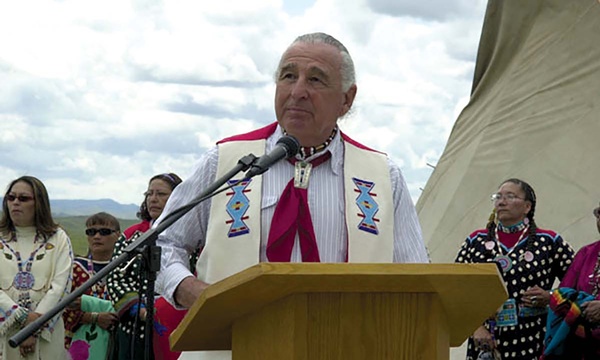
Former Colorado Sen. Ben Nighthorse Campbell speaks at the dedication of the Little Bighorn Battlefield Memorial in Montana in 2003. He entered politics in 1982, first serving as a state legislator, going on to three terms as a U.S. congressman and two terms in the U.S. Senate. He died Dec. 30 at his ranch in Ignacio at the age of 92./ Photo courtesy U.S. National Archives and Defense Visual Information Distribution Service
Ben Nighthorse Campbell, the former U.S. senator and congressman from Colorado who served first as a Democrat and then a Republican, died of natural causes Dec. 30, 2025, at his ranch in Ignacio at age 92.
A member of the Northern Cheyenne Tribe, Campbell grew up poor and spent part of his childhood in a California orphanage, yet he led a life of excelling. He became a judo champion in 1963, winning a gold medal at the Pan-American Games; served in the Air Force for four years where he earned his GED; went on to get degrees in physical education and fine arts at San Jose State University; and honed skills as a silversmith and jeweler. His Western belt buckles were prized.
He entered politics in 1982, first serving as a state legislator. He was next elected to the U.S. House of Representatives, serving rural Western Colorado from 1987-93, then was elected to two terms in the U.S. Senate.
When Campbell switched from being a registered Democrat to a Republican in 1995, “the switch was shocking and traumatic to his staff,” Ken Lane, his longtime chief of staff, said. Lane quit soon after Campbell’s announcement.
Lane said there was lots of speculation about why Campbell became a Republican. A major irritant for Campbell, Lane recalled, was what the senator called the “elitist” attitude of Democratic leaders in Denver and Boulder, who found him too moderate. Campbell’s main support always came from the union stronghold of Pueblo.
It was known that Republican majority leader Sen. Bob Dole, R-Kansas, courted Campbell to make the switch, and once he did, Campbell was appointed chair of the Senate Indian Affairs Committee. Campbell relished the job, advocating for tribal rights and spurring the creation of the Sand Creek Massacre National Historical Site in Colorado, where two of his ancestors had been killed by U.S. soldiers.
Dea Jacobson, who worked in Campbell’s Grand Junction office when he was a Democrat, called him a force of nature. “He could do anything he put his mind to,” she said. He was a licensed pilot and also earned a commercial driver’s license, which he used in 2000 and 2012 to drive Colorado Christmas trees to the Capitol in Washington, D.C.
Though his party affiliation changed, Jacobson said, Campbell’s politics remained the same: “He was pro-choice, pro-union and, despite criticism from some environmentalists, he backed key legislation protecting Colorado’s public lands.” Over the years, Campbell became known as someone who’d horse trade to pass the bills he cared about.
One of his major victories was passage of the Colorado Wilderness Act of 1993, which designated or expanded 19 wilderness areas in the state. The landmark legislation had been 13 years in the making. Campbell also worked on the creation of Great Sand Dunes National Park and helped make the Black Canyon National Monument a national park.
Campbell had a major impact on Colorado’s Four Corners region. Working with local tribes, he helped complete the Animas-La Plata Water Project, fulfilling long-overdue water rights held by the Southern Ute and Ute Mountain Ute tribes.
I’d called Campbell last October when I was writing a column about changes coming for the reservoir named after him – Lake Nighthorse – authorized by Congress in 1968 as part of the Animas-La Plata Project. I’d been told Campbell was in poor health, but he answered the phone, later telling me, “I’m suffering from old persons’ problems, so I’m not following water wars these days. But don’t forget what Mark Twain said about water: ‘Whiskey is for drinking, and water is for fighting.’”
Jacobson wasn’t surprised that Nighthorse was affable in our conversation. “He loved newspaper people,” she recalled, and when they were on the road in rural Colorado, “he liked to stop in at a town’s weekly paper.” Though he didn’t drink, he might also visit a local bar or café to start a conversation with locals. Before long, she said, “he was holding court.”
Lane’s recollection was equally warm. “Ben was funny, irreverent and endearing, and he connected with people of all backgrounds.”
A private memorial service will be held by his family at their ranch in Ignacio. He is survived by his wife, Linda; his children Colin and Shanan; and four grandchildren.
Dave Marston is the publisher of Writers on the Range, an independent nonprofit dedicated to spurring lively conversation about the West. He lives in Durango.
-

- 06/04/2026
- Tougher on trash
- By Missy Votel
-
As human-bear conflicts rise, new state law targets ‘knowingly’ allowing attractants
- Read More
-
- 06/04/2026
- Redefining the business of art
- By Parker Yamasaki / The Colorado Sun
-
Colorado’s new A Corp model helps creatives retain control while attracting investment
- Read More
-
- 05/28/2026
- Quick 'n' Dirty
- By Missy Votel
-
Help for the Demon Bridge, Highway 550 N closure, and fire mitigation falls off
- Read More
-

- 05/28/2026
- Getting crafty
- By Haylee May / Colorado Public Radio
-
Colorado brewers buck national trend by adapting to changing times
- Read More
- Getting gassed
- 06/04/2026
-
Gas prices are once again giving America something to complain about. And while the local beer meisters at Ska Brewing can’t fix the price at the pump, the brewery is offering one small bit of relief: a new light beer that costs one cent less than the price of a gallon of unleaded gas.
Introducing Ska’s newest brew: West’s Easy Light Lager, because “everything else is so hard.”
- Short legs, big party
- 05/28/2026
-
On most days, Tracy Harwood spends her time as a court clerk for the City of Durango. But next Thurs., June 4 – International Corgi Day – she hopes to bring something entirely different to town: short legs, wiggly butts and oversized personalities.
- River cowboy
- 05/21/2026
-
It’s a mash-up made in Westernwear heaven. Sort of. Seems Chaco, the purveyor of the iconic strappy dirtbag river rat footwear, has joined forces with Wrangler, as in tight jeans, big belt buckles, bull riding and snap shirt fame.
- Making plans
- 05/14/2026
-
Wondering what’s up with the old 9-R Admin building at the end of E. 2nd Avenue that was going to be a fire department, then wasn’t going to be a fire department and is now going to be City Hall and the Police Department?The City of Durango will demystify plans for the historic building during a public session Wed., May 20, 5:30-7:30 p.m. at the Durango Recreation Center.