
Back in the crosshairs
Utah's San Juan County continues to be a radioactive target
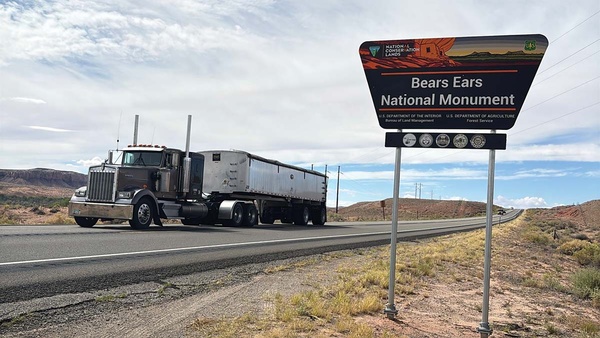
An Energy Fuels truck carries uranium ore from a mine near the Grand Canyon through Bears Ears National Monument to the White Mesa Mill in San Juan County, Utah. About 10 trucks carrying radioactive ore make the trip every day. / Photo by Zak Podmore
In the early 1980s, southeast Utah was targeted as a potential dump site for high-level nuclear waste, the kind that comes from nuclear reactors. The Department of Energy considered storing 8,000 tons of this highly radioactive material near Canyonlands National Park, boosting the idea as spurring “nuclear tourism.”
Who wouldn’t want to see Delicate Arch in the morning and casks of plutonium in the afternoon?
Like the radioactive waste itself, some bad ideas won’t disappear. Southeast Utah is in the crosshairs once again, aided by a $2 million Biden-era grant given to two pro-nuclear nonprofits based in California, Mothers for Nuclear and Native Nuclear, along with North Carolina State University.
San Juan County, Utah, where I live, is Utah’s only majority-Indigenous county and the state’s poorest. Last year, the county hosted a number of meetings as part of the Energy Department’s “consent-based siting consortia,” an attempt to get buy-in from residents for accepting radioactive waste. At local meetings, Mothers for Nuclear argued that the nuclear industry is much safer than the public has been told.
It’s true that 40 years ago, some locals eagerly pushed for a nuclear dump. One pro-repository activist in Moab even called it preferable to national parks, because parks attracted “drugs, homosexuals and environmentalists.” Utah’s governor opposed the dump plan, however, and after it was defeated, the town of Moab worked to create a new identity. Now, the Moab area has become an international tourist destination.
Yet, the question of what to do about spent nuclear fuel remains, and the area surrounding Bears Ears National Monument and Canyonlands continues to be targeted as a suitable dumping ground.
Would welcoming radioactive waste lead to an economic revival? Probably not.
Though the Cold War rush for uranium created economic booms for San Juan County and Grand County’s town of Moab, prosperity spawned public health crises. Residents of Monticello, San Juan County’s seat, and the site of a uranium mill from 1942-60, awoke to a fine yellow dust on windowsills during the mill’s heyday. Decades later, rates of lung and stomach cancer in the town were found in one study to be twice the state average.
The Navajo Nation experienced widespread uranium mining in the 20th century, followed by one of the highest incidences of uranium-linked health issues in the United States. In 1979, Tribal land was also the site of the second-largest accidental release of radioactive material in history, after a wastewater pond burst near Church Rock, N.M. Only the Chernobyl meltdown seven years later surpassed that disaster.
Mills for processing uranium are also harmful. After a mill site in Halchita, Utah, was capped in the early 1990s, workers who cleaned it up fell victim to some of the same diseases as uranium miners of the previous generation. Still contaminating air, livestock and humans are more than 500 unreclaimed uranium mines on Navajo land.
The Navajo Nation banned uranium mining in 2005 and uranium transport in 2012. But Energy Fuels, the company that operates the White Mesa uranium mill just outside San Juan County, secured an exemption from the transport ban in early 2025. The mill has been accepting radioactive waste for years, including waste from Japan and Estonia. Recently, it began processing ore from a mine the company owns just outside Grand Canyon National Park.
Around 10 trucks leave the Arizona mine each day, crossing unceded Havasupai and Hopi lands, the Navajo Nation, and the Ute Mountain Ute Reservation before reaching the mill – all over the objections of Tribal leaders and members of the tribes along the route.
But that waste and ore is far less radioactive than the spent nuclear fuel that Mothers for Nuclear promotes at San Juan County meetings. There, the group stays away from discussing cancer rates or birth defects, instead showing slides of pregnant, smiling women sitting next to containers of nuclear waste.
It is going to take time and vigilance, but once again my fellow residents of San Juan County intend to fend off the Department of Energy, which has adopted even more pro-nuclear policies under President Trump.
Zak Podmore is a contributor to Writers on the Range, an independent nonprofit dedicated to spurring conversation about the West. He is the author of ‘Life After Deadpool.’ He lives in Bluff, Utah.
-
- 06/04/2026
- Tougher on trash
- By Missy Votel
-
As human-bear conflicts rise, new state law targets ‘knowingly’ allowing attractants
- Read More
-

- 06/04/2026
- Redefining the business of art
- By Parker Yamasaki / The Colorado Sun
-
Colorado’s new A Corp model helps creatives retain control while attracting investment
- Read More
-
- 05/28/2026
- Quick 'n' Dirty
- By Missy Votel
-
Help for the Demon Bridge, Highway 550 N closure, and fire mitigation falls off
- Read More
-

- 05/28/2026
- Getting crafty
- By Haylee May / Colorado Public Radio
-
Colorado brewers buck national trend by adapting to changing times
- Read More
- Getting gassed
- 06/04/2026
-
Gas prices are once again giving America something to complain about. And while the local beer meisters at Ska Brewing can’t fix the price at the pump, the brewery is offering one small bit of relief: a new light beer that costs one cent less than the price of a gallon of unleaded gas.
Introducing Ska’s newest brew: West’s Easy Light Lager, because “everything else is so hard.”
- Short legs, big party
- 05/28/2026
-
On most days, Tracy Harwood spends her time as a court clerk for the City of Durango. But next Thurs., June 4 – International Corgi Day – she hopes to bring something entirely different to town: short legs, wiggly butts and oversized personalities.
- River cowboy
- 05/21/2026
-
It’s a mash-up made in Westernwear heaven. Sort of. Seems Chaco, the purveyor of the iconic strappy dirtbag river rat footwear, has joined forces with Wrangler, as in tight jeans, big belt buckles, bull riding and snap shirt fame.
- Making plans
- 05/14/2026
-
Wondering what’s up with the old 9-R Admin building at the end of E. 2nd Avenue that was going to be a fire department, then wasn’t going to be a fire department and is now going to be City Hall and the Police Department?The City of Durango will demystify plans for the historic building during a public session Wed., May 20, 5:30-7:30 p.m. at the Durango Recreation Center.