
The $340 dilemma
Artificial intelligence wants to inhale my Montana book

Recently, my publisher told me that a major technology company involved in the development of artificial intelligence (AI) wants to use my book, “Stories from Montana’s Enduring Frontier,” for “AI training purposes.”
I would earn, the representative explained, $340 for “this one-time use.” Is that one-time use like a wet wipe – disposable, expendable, easily sacrificed?
“Stories from Montana’s Enduring Frontier” collected 20 years’ worth of my essays to argue that 20th-century Montanans developed unique views of how nature worked, as captured in the wilderness-adventure and resource-extraction connotations of “the frontier.” The book felt particularly foreign to anything in the world of AI.
All the writers I know feel particularly vulnerable to AI. Most of today’s commercial AI programs are “large language models,” with skills not in logic, reasoning or math but merely in generating text. That directly threatens writers’ jobs.
Worse, replacing a human writer with today’s generative AI is like replacing a wild raspberry with an artificially flavored Crystal Light. The error-filled, uncreative products of AI threaten not only writers but also the joy and usefulness of reading.
While most people fulminate abstractly about AI, this query about buying my book presented a clear choice, sharpened by the specificity of “$340.” If I took the offer, would the knowledge I poured into these essays become available from AI, decimating my book sales? If my royalties thus fell to zero because I had signed a death warrant for a book-that-is-like-a-child-to-me – was the $340 worth it?
Perhaps $340 was better than nothing. Many technology companies train AI models by stealing from authors. “Stories from Montana’s Enduring Frontier” was among four of my books pirated for the “LibGen” database, which was used to educate AI programs from Anthropic and Meta. Although Anthropic recently settled a resulting lawsuit, Meta and others may yet escape punishment.
What is the proper value of my book? Although $340 is not much compensation for all the work I put in, neither is a royalty of $1.19 per book sold. If my main goal was adequate market compensation for my writing, I probably shouldn’t have published a book in the first place. The book is now 12 years old. At current sales rates, it would take a few years to make $340 in royalties.
When I talked with friends about this dilemma, it felt like none of us knew how to think about the situation. Maybe, as with previous technologies, making the book more widely available will stimulate sales – or maybe not. Maybe AI will thwart young people’s ability to engage in intellectual careers – or maybe its perils are overhyped.
Maybe AI will swallow my entire output without fair compensation. We know that Anthropic and Meta have already tried.
My publisher wouldn’t say which AI company made the offer, how it arrived at that take-it-or-leave-it price, or how it would use my book. Would I feel differently about the deal if AI contributed to the world’s knowledge rather than merely helping students cheat?
As I thought about this, I realized I was reflecting a distinctly human desire, rather than an AI desire. A large language model consumes a book as data. Its model requires ever more data to predict what the next word in a sentence should be.
It’s certainly ego-deflating to think of the product of my research, extensive reading, interviewing, thinking and finally writing as “data.” I’d prefer it to be “knowledge” or even “wisdom” that the AI wants to suck from me. I’d prefer to think that it needs my well-told stories, my keen insights, my brilliant larger points.
But AI doesn’t think in such big-picture terms. It just predicts a word, and then another word, and then another. I realized that this is also a model for how nature works. There’s no grand plan. No knowledge. No story with a satisfying ending. There’s just a single cell reproducing. One leaf reaching for sunlight. A predator seeking its next dinner.
John Clayton lives in Montana and is a contributor to Writers on the Range, an independent nonprofit dedicated to spurring lively conversation about the West, writersontherange.org. Read his newsletter at naturalstories.substack.com.
-
- 06/04/2026
- Tougher on trash
- By Missy Votel
-
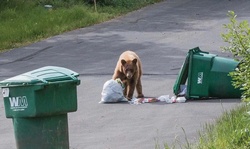
As human-bear conflicts rise, new state law targets ‘knowingly’ allowing attractants
- Read More
-

- 06/04/2026
- Redefining the business of art
- By Parker Yamasaki / The Colorado Sun
-
Colorado’s new A Corp model helps creatives retain control while attracting investment
- Read More
-
- 05/28/2026
- Quick 'n' Dirty
- By Missy Votel
-
Help for the Demon Bridge, Highway 550 N closure, and fire mitigation falls off
- Read More
-

- 05/28/2026
- Getting crafty
- By Haylee May / Colorado Public Radio
-
Colorado brewers buck national trend by adapting to changing times
- Read More
- Getting gassed
- 06/04/2026
-
Gas prices are once again giving America something to complain about. And while the local beer meisters at Ska Brewing can’t fix the price at the pump, the brewery is offering one small bit of relief: a new light beer that costs one cent less than the price of a gallon of unleaded gas.
Introducing Ska’s newest brew: West’s Easy Light Lager, because “everything else is so hard.”
- Short legs, big party
- 05/28/2026
-
On most days, Tracy Harwood spends her time as a court clerk for the City of Durango. But next Thurs., June 4 – International Corgi Day – she hopes to bring something entirely different to town: short legs, wiggly butts and oversized personalities.
- River cowboy
- 05/21/2026
-
It’s a mash-up made in Westernwear heaven. Sort of. Seems Chaco, the purveyor of the iconic strappy dirtbag river rat footwear, has joined forces with Wrangler, as in tight jeans, big belt buckles, bull riding and snap shirt fame.
- Making plans
- 05/14/2026
-
Wondering what’s up with the old 9-R Admin building at the end of E. 2nd Avenue that was going to be a fire department, then wasn’t going to be a fire department and is now going to be City Hall and the Police Department?The City of Durango will demystify plans for the historic building during a public session Wed., May 20, 5:30-7:30 p.m. at the Durango Recreation Center.