
The shape of change
Fifty years on, Great Salt Lake's morphing Spiral Jetty continues to inspire awe
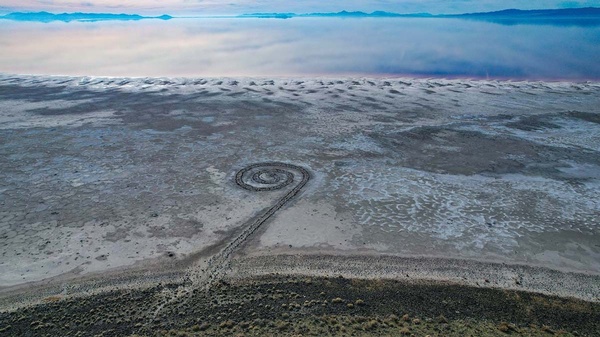
The Great Salt Lake's Spiral Jetty, perhaps the world's most widely known earthwork, was completed in 1970 by artist Robert Smithson. Once submerged under the lake's foamy waters, the work demonstrates just how far the lake has receded. / Photo by Dennis Hinkamp
When life becomes too turbulent, I like to visit Robert Smithson’s most famous work of art, “Spiral Jetty.” He completed it in Utah in 1970. Three years later, both he and the jetty were gone. The jetty was drowned by the fickle Great Salt Lake, now in decline, and it didn’t resurface for about 20 years. When he died in a plane crash, Smithson was only 35.
Perhaps the world’s most widely known earthwork, it cost the artist less than $10,000 and took only six weeks to construct, thanks to rented heavy equipment and a hired crew. Smithson created other earthworks, but none received near the attention of the Spiral Jetty. It is 1,500-foot-long and 15-foot-wide, and the locally excavated basalt rock and mud extends about 600 feet into the lake, curling inward twice, counterclockwise.
It juts out from a remote northern beach of the Great Salt Lake that was the site of failed oil explorations. The black-gold rushers of the 1930s left most of their equipment behind, and what little oil they found filled black puddles afterward. The other-worldly decadence of this place is said to be what attracted Smithson, and a word closely associated with his land art is “entropy,” a slide toward disorder and randomness. What Smithson might never have anticipated is that his artwork was added to the National Register of Historic Places in 2024.
But Smithson knew his jetty would start changing the minute he finished it, and he made no effort to tidy up its shape or surroundings.
From ground level, it looks like a jumbled pile of rocks. It’s only from above that its distinct lines take shape. A visible change is that years of submersion added a cupcake-icing of salt to the black rocks.
My partner of 30 years and I went on one of our first dates to see the jetty, which is 15 miles from Golden Spike National Historic Park. But once there, we found ourselves looking around in frustration and shouting, “Where is it?” because in the early 1980s, the jetty was completely covered by Salt Lake’s foamy waters.
The northern end of the lake is now sometimes Barbie-pink, just as it was when Smithson decided to stack rocks there into art. The pink is from the microorganisms that thrive in the increasingly salty water of the lake. When we visit the park these days, we watch people walk on the rocks and marvel at how much the lake has dried up and how far it’s receded since our first visit.
In academic circles, Spiral Jetty has probably been written about more than any other land art. Smithson’s work is said to express the intersection of landscape, art and environmental history, and while most art in a museum is a snapshot in time, earthworks are always changing. Whatever you choose to call it, Smithson’s approach is spreading. During the COVID pandemic when indoor art didn’t seem accessible, the jetty gained popularity, and Utah’s Box Elder County made significant road and sign improvements to accommodate the crowds.
However, not all land art is celebrated. “Stop stacking rocks” is a sign I never thought I would see, but the do-it-yourself rock art that tourists try to create damages ecosystems, with desert parks harmed the most. Ecologists say that the act of moving rocks harms stream beds and the wildlife that lives among the rocks. Some visitors have also taken to emulating British artist Andrew Goldsworthy, who creates ephemeral works with rocks, trees and plants.
Spiral Jetty may be well known, but it’s still remote. When I go there now, it’s with a better camera and a drone. Though the road has been improved, it’s still a quiet place with no cell service, and always, when I round the corner to the now-expansive beach where the jetty morphs into its next chapter, I feel a dose of awe.
Dennis Hinkamp is a Utah writer and contributor to Writers on the Range, writersontherange.org, an independent nonprofit dedicated to spurring lively conversation about the West. The academic paper, “Reframing the Landscape: Robert Smithson’s Spiral Jetty,” by Amy Reid, examines the lasting significance of Smithson’s 1970 earthwork. ■
-

- 06/04/2026
- Tougher on trash
- By Missy Votel
-
As human-bear conflicts rise, new state law targets ‘knowingly’ allowing attractants
- Read More
-
- 06/04/2026
- Redefining the business of art
- By Parker Yamasaki / The Colorado Sun
-
Colorado’s new A Corp model helps creatives retain control while attracting investment
- Read More
-
- 05/28/2026
- Quick 'n' Dirty
- By Missy Votel
-
Help for the Demon Bridge, Highway 550 N closure, and fire mitigation falls off
- Read More
-

- 05/28/2026
- Getting crafty
- By Haylee May / Colorado Public Radio
-
Colorado brewers buck national trend by adapting to changing times
- Read More
- Getting gassed
- 06/04/2026
-
Gas prices are once again giving America something to complain about. And while the local beer meisters at Ska Brewing can’t fix the price at the pump, the brewery is offering one small bit of relief: a new light beer that costs one cent less than the price of a gallon of unleaded gas.
Introducing Ska’s newest brew: West’s Easy Light Lager, because “everything else is so hard.”
- Short legs, big party
- 05/28/2026
-
On most days, Tracy Harwood spends her time as a court clerk for the City of Durango. But next Thurs., June 4 – International Corgi Day – she hopes to bring something entirely different to town: short legs, wiggly butts and oversized personalities.
- River cowboy
- 05/21/2026
-
It’s a mash-up made in Westernwear heaven. Sort of. Seems Chaco, the purveyor of the iconic strappy dirtbag river rat footwear, has joined forces with Wrangler, as in tight jeans, big belt buckles, bull riding and snap shirt fame.
- Making plans
- 05/14/2026
-
Wondering what’s up with the old 9-R Admin building at the end of E. 2nd Avenue that was going to be a fire department, then wasn’t going to be a fire department and is now going to be City Hall and the Police Department?The City of Durango will demystify plans for the historic building during a public session Wed., May 20, 5:30-7:30 p.m. at the Durango Recreation Center.